


Private Equity 2026 Outlook: AI, Deals, and What's Next
The private equity 2026 outlook is a study in contrasts — and understanding both sides of the picture is the difference between reactive and strategic.
Deal pipelines are moving slowly. Geopolitical uncertainty has created what BluWave Founder and CEO Sean Mooney describes as a "Groundhog Day" effect: macro shocks keep resetting transaction timelines just as momentum builds, leaving deal teams stuck in a familiar loop. And yet, beneath that surface-level stall, the firms that are winning aren't waiting for markets to open up. They're using the pause to accelerate.
On Episode 142 of Karma School of Business, Mooney unpacked BluWave's Q1 2026 Private Equity Insights Report — drawing on data from interactions across more than 500 PE firms to deliver a clear-eyed private equity 2026 outlook. Three signals stood out: AI adoption has crossed a critical threshold, the underlying economy is more resilient than headlines suggest, and the deal rebound isn't a question of if — only when.
The Deal Slowdown Is Real — and It Has a Name
The first thing PE professionals need to understand about the current market: the slowdown isn't simply a function of high interest rates or tight credit. It's behavioral.
Geopolitical shocks — trade policy disruptions, tariff uncertainty, shifting regulatory environments — are creating cascading effects on deal conviction. Sellers specifically need four to six months of clear visibility before they're willing to commit to a transaction. When macro conditions shift every few weeks, that window never fully opens.
Mooney characterized this dynamic on the episode as a "Groundhog Day" scenario. Each time deal momentum builds, a new geopolitical development resets seller expectations and pushes timelines out again. For deal teams, the result is a familiar frustration: pipelines that look full but convert slowly.
For portfolio operators, however, the same dynamic creates an unintended strategic gift — time. Time to do the value creation work that typically gets deprioritized during active deal cycles. Time to upgrade teams, build operational infrastructure, and implement the technology changes that create durable enterprise value before the next close.
The practical read for PE firms right now: don't mistake a slow close rate for a soft market. The underlying deal interest hasn't disappeared. What's missing is the macro stability required to translate that interest into signed term sheets. When that stability returns — and it will — the backlog will move quickly.
AI Has Crossed from Experiment to Execution
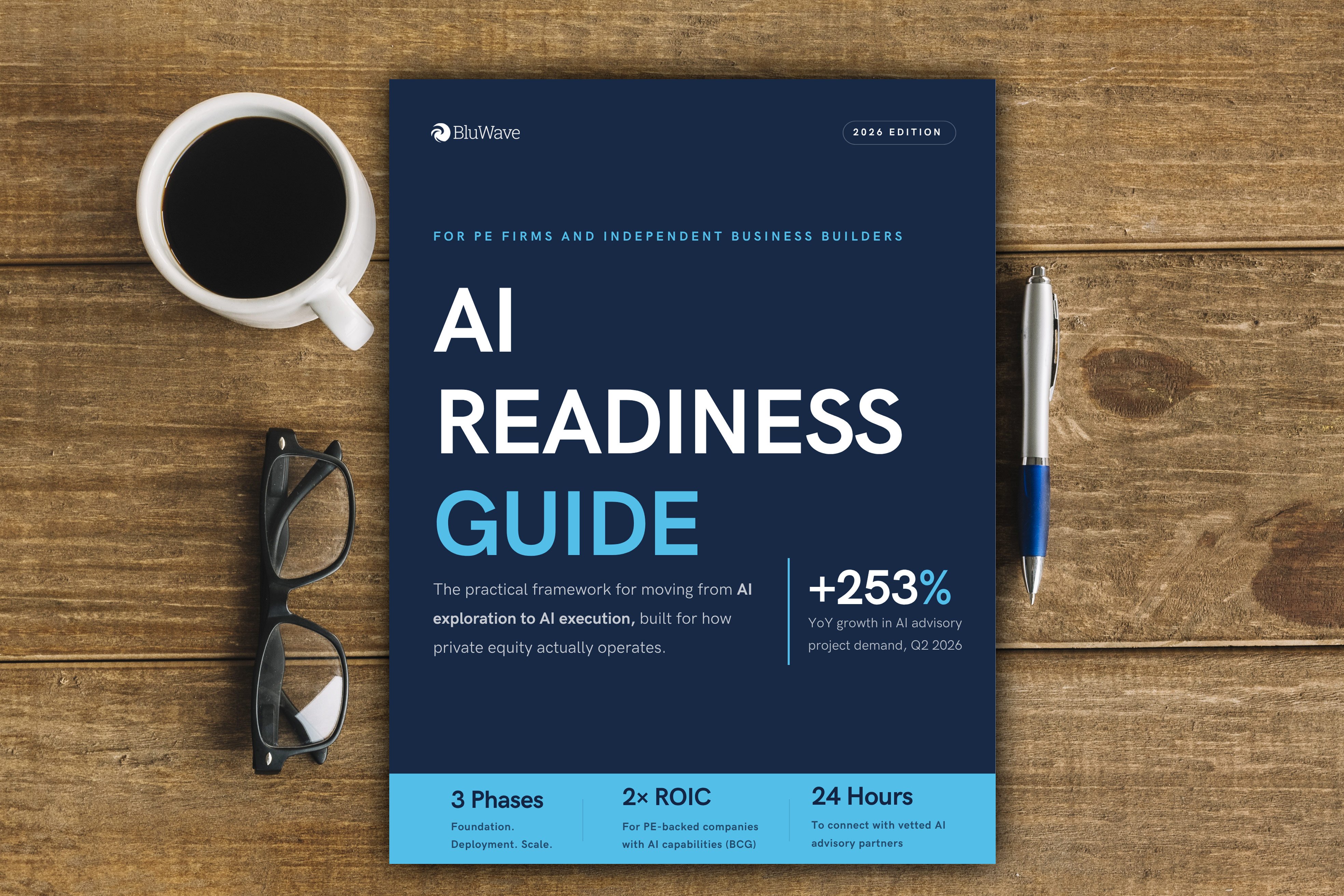
The most significant signal in BluWave's Q1 2026 data — the one that should command the most attention from operating partners and deal teams — is this: AI demand among PE firms and their portfolio companies has surged 280%.
That number is remarkable not just for its scale, but for what it represents qualitatively. Mooney was direct on the episode: the private equity industry has passed the experimental phase. Firms are no longer asking whether to integrate AI into their operations. They're asking how — and they're deploying resources to do it now.
This shift from exploration to execution changes the competitive landscape materially. The firms that spent 2024 and early 2025 testing AI tools in controlled environments are now scaling those implementations across portfolio companies. The firms just beginning to evaluate options in mid-2026 are, by definition, operating from a disadvantage.
Data readiness is the new competitive moat. Mooney flagged this as the defining factor for successful AI execution: firms with clean, structured, accessible data can move immediately. Firms with fragmented data infrastructure — common across many middle-market portfolio companies — face a months-long remediation effort before AI tools can deliver meaningful value.
For due diligence teams, this creates a new evaluation criterion for every platform acquisition: assess data infrastructure quality alongside the traditional commercial and financial review. A company's ability to leverage AI isn't a technology question — it's a value creation question, and the gap between data-ready and data-fragmented businesses will widen at an accelerating rate.
For operating partners already inside portfolio companies, the priority is equally clear: don't wait for a perfect data environment to start. Begin with the highest-value use cases — customer analytics, procurement optimization, financial reporting automation — and build from there. BluWave's work on practical AI implementation for PE firms offers a grounded starting point for teams at any stage.
The Economy Is More Resilient Than It Looks
Here is the counterintuitive read from BluWave's Q1 2026 data: despite inflation pressures, tariff uncertainty, and market volatility, the underlying economy remains unexpectedly robust.
This matters for PE professionals in two ways.
First, it means portfolio company fundamentals are generally holding. Operating teams should resist the temptation to over-index on macro noise. Revenue isn't collapsing. Consumers are still spending. Businesses are still investing. The conditions that made a portfolio company attractive at acquisition haven't fundamentally deteriorated — even if sentiment has.
Second, it creates a strategic asymmetry for firms willing to maintain conviction. If the economy is stronger than market sentiment reflects, current valuations in some segments may carry a fear premium that doesn't match actual business performance. For buyers with dry powder and a disciplined view of intrinsic value, that's an opportunity — not a reason to stand down.
The firms that have outperformed through every market cycle are those that maintain a consistent analytical framework while others are distracted by sentiment swings. BluWave's data suggests the fundamentals still support that discipline across most sectors in the current PE deal market 2026 environment.
How Leading Firms Are Responding Right Now
The firms Mooney described on the episode aren't sitting still waiting for the deal market to recover. They're executing two strategies simultaneously — and the combination is what separates top-quartile performers from the rest.
Doubling down on value creation
When deal activity slows, the best PE firms redirect energy toward existing portfolios. This means accelerating operational improvements, upgrading leadership where gaps exist, and implementing the technology and process changes that create durable enterprise value ahead of the next exit cycle.
This isn't a pivot — it's a reprioritization. Firms that consistently build value between deal cycles produce better returns on current holdings and develop the operational playbooks and expert networks that make the next platform acquisition more successful, faster. Revisiting your 100-Day Value Creation Playbook is a concrete starting point for any portfolio leadership team looking to sharpen execution in this window. For a deeper look at the team infrastructure required to execute value creation at speed, Episode 141 on building PE value creation teams is essential listening.
Building AI execution capacity before the rebound
The window to build AI capability without full competitive pressure is narrowing. Firms that use the current slowdown to identify data infrastructure gaps, train teams, and pilot high-ROI AI use cases will enter the next deal cycle with a meaningful structural advantage — both in how they operate existing holdings and in how they evaluate acquisition targets.
The 280% surge in AI demand Mooney cited isn't a trend that reverses when deals pick back up. The pace will accelerate as AI tools mature and competitive pressure intensifies. The firms building capability now will compound that advantage. The firms that wait until the market reopens will find themselves building under time pressure, competing against buyers who already have the operational infrastructure in place.
The Deal Rebound Is Inevitable — Here's Why
If you take one thing from Mooney's Q1 2026 analysis, let it be this: the deal market will come back, and when it does, it will move quickly.
The math isn't complicated. Dry powder — the undeployed capital sitting in PE funds — has been accumulating for more than two years. Limited partners expect returns. Fund timelines have expiration dates. At some point, the pressure to deploy capital outweighs the preference to wait for perfect conditions.
Sellers will recalibrate to the prevailing rate environment. The four-to-six-month visibility window will open, and when it does, pent-up transaction volume will clear fast.
For firms that have spent the slow market building — upgrading portfolio operations, developing AI capabilities, maintaining deal sourcing relationships — the rebound will be a moment of advantage. For firms that spent it waiting, the rebound will be a scramble to catch up against better-prepared competitors.
This pattern has played out through every PE market cycle. BluWave's data suggests the current slowdown is following the same trajectory. For teams looking to understand how to prepare their diligence and deal execution capabilities for the coming wave of transactions, this episode on commercial due diligence preparation is required reading.
Key Takeaways for PE Firms in 2026
- The slowdown is behavioral, not permanent. Sellers need 4–6 months of macro visibility before committing — when stability returns, backed-up pipelines will convert quickly.
- AI adoption has crossed a threshold. Demand is up 280% as firms shift from testing to execution. The competitive gap between early movers and laggards is growing.
- Data readiness determines AI ROI. Diligence teams and operating partners should treat data infrastructure as a first-class value creation lever — starting now.
- Underlying fundamentals are holding. Don't let macro noise obscure solid portfolio company performance or distort your view of acquisition opportunities.
- The deal rebound is when, not if. Dry powder, LP pressure, and pent-up deal interest will drive a rapid recovery. Build now to move decisively when it arrives.
Work with BluWave to Execute Now
BluWave connects PE firms and their portfolio companies with pre-vetted, PE-grade service providers — from AI implementation specialists and data infrastructure consultants to commercial due diligence experts and operational leadership talent — on the timelines that deal cycles demand.
With proprietary demand data from interactions across 500+ PE firms, BluWave's team knows which resources move the needle at portfolio companies, and which ones slow you down.
Whether you're building AI capability in your portfolio today or preparing your deal execution infrastructure for the coming market recovery, start a project with BluWave to access the right resources, fast — always free.
PE Activity Pulse
Weekly demand data from 500+ PE firms. What they are asking for. Before anyone else knows.
✓ You're in! Watch your inbox.
No spam. Unsubscribe anytime.

Connect with
a pre-vetted
resource now
Do you need an exact-fit, PE-grade, third-party resource for your nuanced due diligence, value creation, or prep-for-sale work? We've got you covered.
To learn more or start a project, contact our client success team at 615-588-4010 or fill out the form to have us call you.