





Home
>
Resources
>
Podcast
>
Karma School of Business
>
Private Equity in 2026: AI, Deal Slowdowns, and What Comes Next
Private Equity in 2026: AI, Deal Slowdowns, and What Comes Next
Podcast
Private Equity Firms
AI
Karma School of Business
EPISODE 142
Private Equity in 2026: AI, Deal Slowdowns, and What Comes Next
Sean Mooney, Founder and CEO of BluWave, breaks down the firm’s Q1 2026 Private Equity Insights Report and what it signals for investors and operators navigating a volatile environment. He outlines how geopolitical shocks are once again stalling deal activity, why the economy remains surprisingly resilient, and how private equity firms are leaning harder into value creation. Sean also explains the shift of AI from buzzword to real execution—and why data readiness is now a competitive imperative. This is a clear-eyed view of the current market and where private equity leaders should focus next—hit play.
Episode Highlights
- 1:15 - “Groundhog Day” returns as geopolitical shocks stall deal momentum
- 3:20 - Why sellers pause deals: the need for 4–6 months of visibility
- 5:30 - Economic resilience despite inflation, tariffs, and uncertainty
- 7:10 - PE firms increase focus on value creation during market slowdowns
- 10:30 - AI demand surges 280% as firms move from experimentation to execution
- 16:10 - Data readiness becomes the defining advantage in AI adoption
- 23:20 - Why deal activity must rebound: liquidity pressure and dry powder
For more on BluWave, visit: https://www.bluwave.net/
To request the full Q4 2025 Insights Report, visit: https://bluwave.net/resources/insights-report
• 32 min
Private Equity in 2026: AI, Deal Slowdowns, and What Comes Next
Private Equity Podcast: Karma School of Business
Play
Transcript
Sean Mooney:
Welcome to the Karma School of Business podcast about the private equity industry, business best practices, and real-time trends. I'm Sean Mooney, BluWave's founder and CEO. In this episode, we have a special conversation where we're going to talk about BluWave's just released Q1 private equity insights report. Enjoy. Welcome to the Karma School of Business. Today, we have another special episode. BluWave just released its first quarter private equity insights report. This one is a doozy, so we're going to share a little bit about what the private equity industry has been doing during the somewhat tumultuous and flux-filled first quarter of 2026.
The headline is, it's Groundhog Day. For those of you who have seen the movie with Bill Murray and the Groundhog, this is going to make a lot of sense to you. For those of you who have not, the quick synopsis, spoiler alert, this movie took place or was filmed in 1993, so if you haven't seen it by now, I'm sorry. Essentially, what happened was Bill Murray's character is a reporter visiting the Groundhog Day Festival that occurs in Punxsutawney, Pennsylvania each year. You may have seen it on TV. The Groundhog predicts whether or not we have spring or more winter age here. It's always a point of contention in my family. Essentially, Bill's character shows up there. He's reporting on it. He's a jaded curmudgeon. Something happens in the universe. Bill is forced to relive the same day over and over again. Each time though, he plays it a little better and eventually he gets out of the loop. Next thing you know, Bill and the world are in a better place. How is this relevant to this year in the private equity industry is the big question, but I'll tell you. Last year at the beginning of Q1 in 2025, the economy was picking up steam. The deal market flywheel was spinning faster and faster.
There was this tangible feeling of energy in the PE world and many internally in their mind were saying like, let's go. This is awesome. Then tariff liberation day, 12-day war geopolitics came through and it took the wind out of the business builder world sales and things slowed down. Then eventually things calmed and the world took off again and it built strength with every month thereafter through the rest of the year. This year we're reliving that same Groundhog Day again.
As you can imagine, we started off with the economy building, with the deal market strengthening. We were seeing tons of results and then geopolitics, tariffs once again. Much like the movie, this time it appears that the PE world is playing the new version of the same day better than last time. What did we see while equipping PE activity this year in Q1? Number one, Black Swan started flying again as we just talked about. Number two, the economy has remained amazingly resilient during this time. Number three, the PE industry once again sprung into action. Maybe what we'll do here is let's go through each one of these systematically.
First, this year when tariff uncertainty in geopolitical action took place, we saw the deal market predictably stall. We tangibly saw this happen in real life through a meaningful month over month decrease in the amount of due diligence requests that we received each quarter. These are forward-looking measures. People started to see things going, Spidey Sten started going, and they started pulling in the sales. Deal started getting pulled from the market. People started putting pencils down. Then when the latest geopolitical tension occurred, things really slowed down meaningfully. This makes sense. If you think about... In order to take a deal to market, a PE firm needs really four to six months of visibility with calm weather ahead. Why is this? Because the last thing anyone wants to do when they're going to monetize a company that they've built after years and years of hard work is get all their materials together, build the excitement, build the conviction, head to market, and then find out that you're exposed to a thunderstorm or you're crossing a stream and then a big flash flood comes through. You don't want to risk taking a company to market when something could go wrong and completely deflate and wreck everything that you've really spent years going.
It's rational if you're about to go to market and an acute disruption occurs to say, you know what? Wait a minute. Let's hit pause and see what's going on. That's what we've seen. The deals haven't gone away. The Sims, the confidential information memorandums, are all written. It's just that sellers are looking at the horizon and they see the storm coming through. They're saying, you know what? Let's let this thing pass. Then most of them are going to hit the market again when they get comfortable that things have calmed down and they can see a horizon that's free of storm clouds and say, okay, do we think things can stay calm for four to six months ahead? That makes intuitive sense. Hopefully, you'll see on why things in the deal market have come to an abrupt slowdown. Now, the second thing that I shared at the beginning that we saw is that somewhat amazingly, we've seen this economy continue to weather this passing storm amazingly well, once again. If you look at the measures, GDP has been good enough, not great, but good enough. Unemployment, shockingly, still remains at the hot end of the 4% to 5% range of full employment that we look for. Inflation is still high, but not crazily so. Let's just remember the 2% target was established by a central banker in New Zealand in the 1980s and was never a target of the US officially until 2012, if I recall correctly. Inflation is not great by any measure and it's certainly not going down, but it's not in the hit the super concern button. It could be, so don't get me wrong, but something we have to keep an eye on, but it's not in the Code Red Alert. Let's talk about what we've just most recently seen. March PPI rose 0.5% month over month, which was less than half the 1.1% consensus forecast. Core PPI edged up just 0.1%, essentially keeping core inflation steady at 3.8%.
Manufacturing PMI continues to show expansionary measures at nearly 53 points, which shows that the manufacturing industry continues to leave the recession that it had been in over the last multiple years behind it and is evolving into its next cycle. Overall, the economy has been almost astonishingly resilient given all that's going on. Lastly, we've seen the PE industry react with proactivity as it relates to this economy. In the first quarter of 2025, the private equity industry spent 75% of its time focused on value creation activity as measured by all the projects that come through BluWave. Once again, these are hundreds of PE firms, thousands of projects that they're using this for, so it gives a pretty good statistical measure across the entire stack of PE of what they're doing. If we look at Q1, 2026, the PE industry spends 79% of its time on value creation.
That is a material increase in where they're spending time. Now, part of that is because the deal economy is slowed, but part of it is that any time there's a storm, they run towards it. That's one of the great things about the private equity industry. When the storms arrive, they don't huddle up in fear. They run towards the challenge, they take it on, they proactively mitigate the risks, and they turn those risks into opportunities. For those of you who haven't been inside the industry, you might understand why is that? It's because they're just naturally tenacious people. Is it because it's died in the wool? It may be, but it's also because of the fundamental economics of the industry.
Let's look at the venture capital industry as a comparison. The venture capital industry only needs to be right one, maybe two out of 10 times to make money, because they're going to make many, many multiples of their money on those one or two, and then they're going to lose money on the rest. But those few that they make money on are going to be outlandishly successful. What that means is when there's something in trouble, they can kind of pitch up their tent and say, let's wait or let's cut bait, let's focus on and consolidate on the winners.
Now, the private equity industry needs to be right nine and a half times out of 10 to be successful, because they're looking to make two to three times your money. You make it up if you lose money on one of those times. That means any time there's trouble, they run towards their companies and give them all the support they need to be, not only surviving, but also thriving throughout their hold cycles. This also happens to be a tremendously stabilizing benefit for our economy.
Hey, as a quick interlude, this is Sean here. Why don't you address one quick question that we regularly get? We often get people who show up at our website, call our account executives, saying, hey, I'm not private equity. Can I still use BluWave to get connected with resources? And the short answer is yes. Even though we're mostly and largely used by hundreds of private equity firms, thousands of their portfolio company leaders, every day we get calls from every day top proactive business leaders at public companies, independent companies, family companies. So absolutely, you can use this as well. If you want to use the exact same resources that are trusted in being deployed and perfectly calibrated for your business needs, give us a call. Visit our website at bluwave.net. Thanks. Back to the episode. So we once again saw PE taking all sorts of action across categories of value creation during the first quarter as these proverbial storms arrived. Now, they just didn't react to survive. They're also looking towards the future. One of the great things that I found while in the PE industry, but also now serving it for all these years, is that the PE industry has an amazing ability to not only react to the storm, but to look past it and to see the blue skies ahead. What we also saw was not only the protective measures in Q1, we also saw massively running towards the future.
The single biggest headline of Q1 in private equity is AI. That word has been overused and overused. It's been buzzy buzzwords. Now it's actually real. So last year, BluWave got all sorts of calls from the entire private equity industry about AI. Most of what we ended up working on was establishing the data foundations needed to equip and fuel the future opportunities afforded by AI that were on the way. Today, I think there's still a lot of that foundation that needs to happen for sure across probably most companies in the world and certainly in the US.
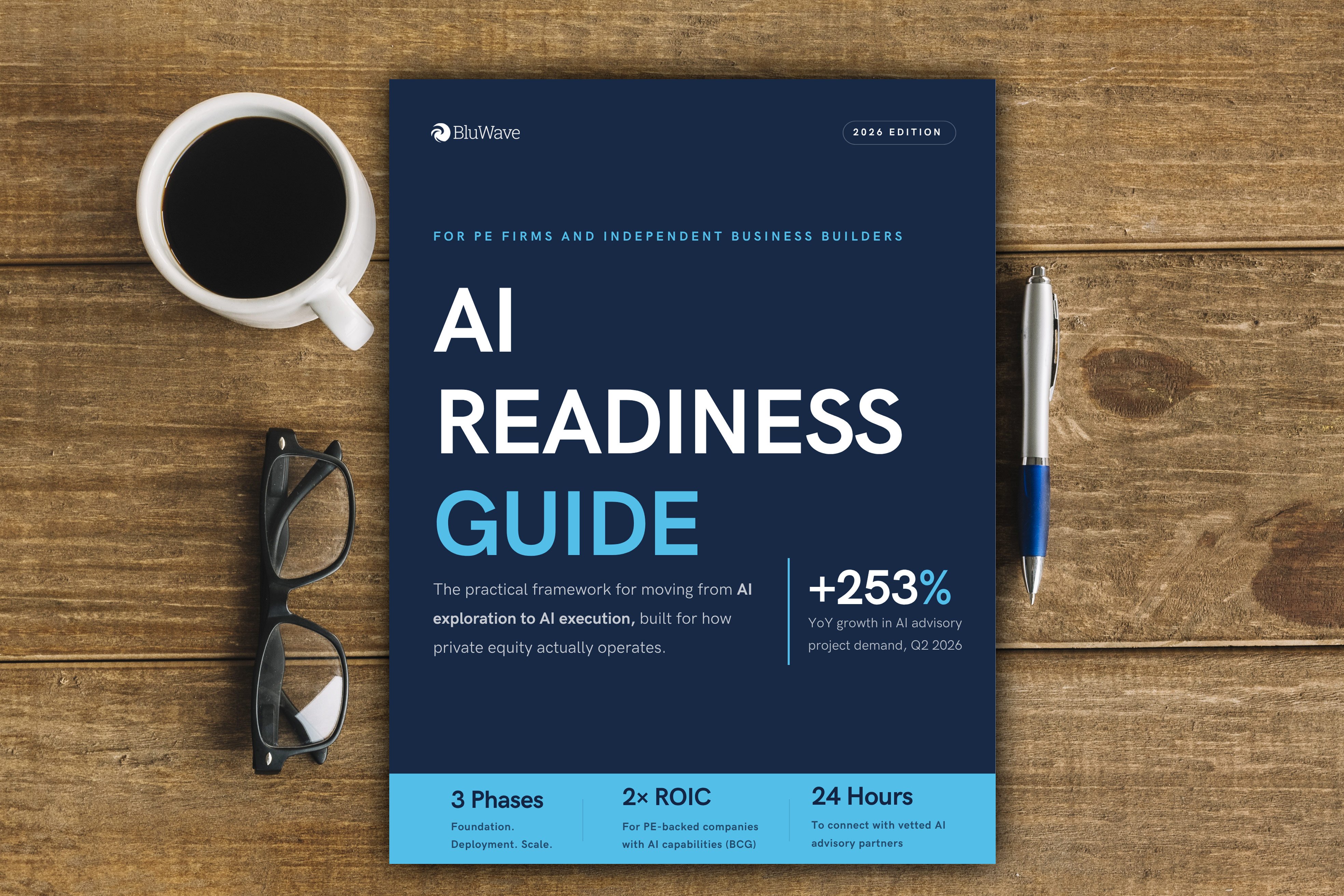
But that's a different story. Let's go beyond that. Now, a lot of the world though has already done that and they've gone past putting the foundations in and now they're enabling all the good things that come when you have a great structured dataset. So the buzzy buzzwords are turning into practical and actual elements of value that you can act on. So what did BluWave see in the first quarter of 2026? We saw a 280% year over year increase in AI project demand.
That's a staggering amount. The takeaway is if you're a private equity firm, a portfolio company, or an independent company, now is the time to start running towards this technology. One thing as a fellow business leader, I feel at the same time as I acknowledge it's daunting. Things are moving so fast. It's incredibly hard to know where to get started. The key thing is you have to take that first step and then you take the next one and then the next one.
But it's even hard to know where do you even take that first step in which direction. If you don't know where to start, give your BluWave account executive a call or reach out to us. We're free to use. We can show you the map and how you actually sequentially get going confidently with real ROI versus doing 100 projects and none of them work. And it's the same thing that we're equipping and have been equipping in the last several quarters actually with the other earlier adopters in the PE industry that they're already doing.
So once again, I can't stress this enough. I think most of the world is sleeping on what is already here and what's to come. This is something you need to run towards. If you do, the world will be your oyster. But if you resist change, this coming change will win. So I'll get off my soapbox on that, but I just can't stress enough. Run towards this. Give us a call. We can help you get there. And it's not meant to be a sales point there, but it's the truth. And so if we can be supportive of you, we're here to do so.
There's a lot more nuance and thematic shifts that are going on. If you'd like to learn more of the details, go to our website and request a copy of our Q1 PE Insights report, or call your BluWave account executive and we'll hop to for you on this. All in all, I think the Ground Hog Day movie reference is a good one. But at the end of the day, we're all being forced to live this repeating loop over again, it seems. The good news is the top business builders are seeing through the noise. I think they're playing these loops better each time.
And they also know that spring is coming just like in the movie Ground Hog Day, not just because there are foundations in place that so far are persisting. And should persist, should we have calm return absent in meaningful escalation or persistence in the noise. But ultimately spring has to come back because it has to. There's just too many dollars at stake. There's too much gravity. There's too much physics at stake for the deal market not to come back and for the economy not to go forward. And this is one of those classic, this too shall pass times.
It seems like I've been saying that a lot lately though, just to be clear. We've talked about what's happened. Now let's talk about what's coming. And so at this point, our conversation, I'll revisit our 2026 predictions that we made to start the year. Let's do a check in and look freshly towards the future here. At the onset of the year, we made five predictions. AI moves from buzzword to tactic, software choice explodes and creates decision paralysis.
The US economy heats up, the private equity deal market continues to remount, and businesses are going to bifurcate into winners and laggards. I'd say up until mid February, I felt really good about all five of them. I think two of them have been impacted by another black swan, which is always the risk. But I do think they all remain intact for this year. Let's go through each one and tell you how we think they're playing out, particularly through the lens of what we're seeing the private equity industry do in real life against these themes and trends here. If we talk about AI moves from buzzword to tactic, we said AI is going to stop being treated as a strategy unto itself, and it's going to become a tactical force embedded directly into everyday workflows. As a Q1 update, I think this prediction is accelerating faster than most in the PE world or even we expected. The takeaway, the time to act is now before this gap winds even further. How do you play this to win?
You got to reevaluate all the functions of your organization through the lens of force multiplication. Use a PE grade provider. We have lots of them that are very good for these things if they're helpful to help you assess these functions where you can enable purposeful AI adoption. Be thoughtful about this. Don't do a hundred projects. Try to pick the winners. Think about each of them in terms of the impact that they'll have and the ease of execution that they'll have. Be mindful of showing people how these things win and you'll get buying faster.
The other thing that I would say for anyone is, and we talked about this a moment earlier, you got to get your data structured and you have to make it useful. The winners in this world are those who have an LLM, a large language model, chat GPT, cloud, that gives you access to the sum total of public knowledge. Well, every company has knowledge that no one else in the world has. So if you couple that private data that you have with the public knowledge that these LLMs bring to you, you're going to be supernaturally intelligent. In order to do that, you got to get your data structured. Spend time on that. And so bring in data transformation, engineering, resources that can help you structure and then semantically notate your data so it knows how to use it. You do that, the world's your oyster.
The other thing that we talked about in the beginning of the year is that AI is going to enable an explosion of software choices and ultimately create decision paralysis. And so what does AI enable? One of the first areas is enabling a hyper acceleration in the ability to code product, to engineer product, to enable software products. And so you all have probably noticed you've got BDR outreach that is exponentially growing in your inbox right now.
And everyone's saying, I've got a better product for this, a better product for that. What does that mean? It's like you've got so much choice likely going on that you have no clue how to decide one tool versus the other. And as soon as you have one tool, another one comes out. And so that's a predictable outcome if you could see the exponential increase in the capacity for these coding tools, whether it's Claude or whether it's Zuchet, GPT, whether it's Windsurf, any of these tools that are making your software developers and these software developers in the world move so much faster. So this was a predictable outcome that we saw growing well into early last year, and now it's starting to reach a fever pitch. What you can do about this is a couple fold. Be really thoughtful about where you can apply the power of these new tools and don't just chase your tail like my dog does running in circles and circles and circles.
Be thoughtful about what you need. The other thing that I can share is that we can be really helpful on this. We have a behind the curtain lens into which software tools are working in which capacities. Don't be afraid to call us. And once again, I don't mean to be salesy on this, but there's things that we know that can be very helpful that can help you make your choice more confidently through the lens of the power of the business builders that we enable and equip every day. The other practical thing that I'd recommend everyone do here, and I've mentioned this before, do your best not to enter into any contracts for more than one year at a time.
Ideally, you're doing monthly because what you don't want to do is lock yourself into a solution and the world runs by it and then you don't have the capacity to catch back up with the world because you've locked yourself into an economic construct that is going to limit you and saw off your ankles. So just practically do what we do. Be really thoughtful about the length of term that you're entering into contracts with. Hi, this is Shawn. I wanted to take a quick moment to tell you a little bit why BluWave exists. It's based on this whole notion that assessing opportunities and building businesses is really hard. We all know third-party expert service providers can dramatically help, but at the same time, it's hard to know who's good, usually leaving you like I would do and call friends and ask, do you know someone who does this or just go the square peg round hole route? So after nearly 20 years in PE, I decided to solve my own problem and create a BluWave. Today, many hundreds of PE firms, thousands of portcos, leading public companies, private companies, all call BluWave to instantly get connected with the exact third-party service provider that they want that's pre-credential by BluWave and perfectly calibrated for their need and really good.
You too can give us a call or visit our website at blueave.net. We're free to use and you can benefit the same way other top PE firms do. Back to the show. The next prediction we talked about was the U.S. economy heats up. We said after years of uneven growth, the economy is positioned to grow meaningfully, the conditions were improving, and there was going to get better and better. I think that was spot on until February. No one's perfect. But here's the thing that we talked about in the beginning. The economy was improving. It is starting strong. The fundamentals and foundations are still there. We had another black swan that swept the wind away and took air out of our sails. The foundations are still there just like our Groundhog Day from last year should calm, be brought back to the market to re-accelerate and continue to grow just as it was before. But we do need a period of calm and we could definitely all benefit from not having a quarterly, massively disruptive event that continues to stall things out.
The amazing thing is our economy is as good as it is and continues to be notwithstanding all of this. What we see the propensity of the business builders and PE industry is that everything is there for its pick back up, but we do need some calm to prevail. What I'd recommend is even if it continues to be noisy, you can't cut your way to prosperity. It works for a little bit, so continue to have a growth mindset. Look at your sales organizations, bring in sales effectiveness groups, top grade your teams, bring in specialized recruiters, all of the same tools that our business builders and PE are using right now, you should be doing the same thing.
Do as they do. They're seeing the world in ways that most people can through a portfolio of companies and a mandate that they have to grow their companies. So there's not a choice there, do as they're doing, and those are two things that they're doing. Now that had been said, it's always a good time to tighten your belt, so don't not do that. There are some really good procurement groups, operational effectiveness groups that can enhance your productivity and cash flows. AI is also a great tool for that.
There's some great enablement tools and enablement advisors that can help you tactically execute that and not have to learn it by watching TikTok and Instagram videos. Get people who know how to do this. The next prediction we made was the private equity market continues to rebound. The structural forces, I think, still continue to remain. There are, I don't know if it's record, but it's pretty darn close to record, if not, amounts of portfolio companies that are out there.
The assets have been on these shelves for a long, long time. The LP world is demanding a return in capital, and they are starting to also demure on the trend towards continuation vehicles, which is a quick aside. I think the continuation vehicle overall, 80%, 90% of the time is a great vehicle that gives optionality to both the GPs and the LPs because you're not forced to sell your best portfolio companies too soon because you need an exit to raise the next fund. So that's a whole different conversation. But I do think the LPs have said, send us back the money, you're not going to get your next fund. And I think you're seeing that play out in real time because fundraising and PE is slowing down. And I don't think it's a returns issue. It's a liquidity issue as it has been over the last year. And so the private equity industry will rebound because it has to. There's too much money at stake. There's too much compulsion by the LPs to return capital. Ultimately, the GPs want to raise their next fund to keep this economic engine of PE going. And so the economics 101 of this means that the deal market will come back, and it will come back in a meaningful way. And that's going to create a greater range of opportunities for both buyers and sellers. When it does come back, and you will see it come back this year, there's still a lot of capital out there.
So the way to be Econ 101 to make sure you're not purchasing at the intersection of supply and demand, you specialize diligence providers who can provide you real alpha. If you get a generalist group giving you generalist outcomes, you're going to buy at the intersection of supply and demand where the surplus has been skimmed. You need to create alpha in this market because it's too efficient. The groups that specialize in areas are going to see things that others don't because they don't have to call the expert networks and learn it in a four-week sprint.
Talk to the groups that already know what you need. And that's one of the big reasons why PE firms use us for their diligence resources because we know where people are expert and where they have the alpha. The other thing that I would say you should put into your diligence game plan, if you haven't already, is maybe tactically tilt your diligence process as it relates to technology to not only do the checkout of the infrastructure, but you need to understand your target's AI readiness. And as part of that, as I talked earlier, understand their data readiness. All of those are going to be incredibly important in terms of how you can accelerate faster than everyone else in this coming and current age of abundance. People who run towards this are going to have more abundance than you could ever imagine, but you have to be ready to do and you have to know what you need to do before you send a wire to the seller. The last prediction we made, and I'll wrap up after this, is businesses are going to start bifurcating into winners and laggards.
Ultimately, as we shared earlier, I think the vast majority of people, companies, do not understand what is coming and what is already here. And the super benefits that these AI tools are going to provide those who have the audacity to run towards them and use them. And those who use them, this may be 20% and that's probably a generous number, are going to tremendously benefit. And it's not just software companies, it's business services companies, it's consumer businesses, it's healthcare businesses, healthcare products, and technology and services, and it's also manufacturing.
I think the manufacturing companies think they don't have to run through this because they're insulated. Well, they probably are. But if you run towards this faster than others, you're going to benefit faster than others. Don't wait for the world to catch up. Those who run faster, they're going to really separate themselves from the pack and they already are. Those that aren't are going to start lagging meaningfully. It's just the way the world has worked and will work. I just can't overemphasize this. Take that first step, run towards it. And once you do, it becomes fun. But you got to make that first step.
How do you do that? They used to say data is the new oil. Data is now the new gold. You've got to assess your data readiness. If you can, and you have the capacity, you should build a data lake that's going to enable you to bring all your data from all your different systems into one place. You can do that. You can hire groups to help you do that. You can hire a full-time or fractional data resource to help establish the data lake and then maintain it. Just be aware though, this is going to be a full-time recurring investment.
Data is like a piece of machinery. Anything with rotation and force wants to lose calibration. So you're going to have to maintain it. It's going to be the least fun job in the organization, but someone's going to have to do it and you're going to have to put resource and budget against it. But if you do, you're going to benefit immensely, not only now, but in the future when things get even more interesting and fun. The other thing you should do if you don't know where to start, connect with an AI assessment and enablement group that's going to help you identify the opportunities and the foundations that you can A, put in place now and B, start executing on and then C, sequence in terms of order of importance based upon how actionable they are and based upon how much impact they'll have.
The last thing I'll say on these winners and laggards is that don't take your mind off growth. It's easy to get paralyzed during these times of fear, but no one wins by keeping your wagon circle. The pioneers from way back when, they kept on heading west. We need to do the same thing, so keep your eye on growth and keep your eye on proving your operations. Once again, you don't have to build these wheels for the first time. There's groups that can help you. Don't be afraid to ask for help. Run towards the future and the world's going to be a really exciting place. I'll jump off my soapbox here. I hope this was not only helpful in terms of understanding how the private equity industry is taking action and running towards opportunity, but also giving you some tactical ways that you can do things yourself to get going. If you have any questions, as always, BluWave is here to help, reach out to us, and we'll do what we can to support your success. Onward.
That's all we have for today. Please continue to look for the Karma School of Business podcast anywhere you find your favorite podcasts. We truly appreciate your support. If you like what you hear, please follow Five Star Rate, review and or share. This is a free way to support the show and it really helps us when you do this, so thank you in advance. In the meantime, if you want to be connected with the world's best in class, private equity grade, professional service providers, independent consultants, interim executives, AI enablers, software tools that are deployed and trusted by the best business builders in the world, including many hundreds of the top private equity firms and thousands of portfolio companies, and you can do the same whether or not you're in the PE world. Give us a call or visit our website at bluwave.net and we'll support your success. Onward. The views and opinions expressed in this program are those of the individuals presenting and do not necessarily reflect the views or positions of any other persons or entities, including those referenced herein. No representations, warranties, financial, legal tax or other advice are made herein. Consult your advisors regarding any topics discussed during this episode.
Karma School of Business
Private equity insights for and with top business builders, including investors, operators, executives and industry thought leaders. The Karma School of Business Podcast goes behind the scenes of PE, talking about business best practices and real-time industry trends. You'll learn from leading professionals and visionary business executives who will help you take action and enhance your life, whether you’re at a PE firm, a portco or a private or public company.
BluWave Founder & CEO Sean Mooney hosts the Private Equity Karma School of Business Podcast. BluWave is the business builders’ network for private equity grade due diligence and value creation needs.
Related Articles
Connect with
a pre-vetted
resource now
Do you need an exact-fit, PE-grade, third-party resource for your nuanced due diligence, value creation, or prep-for-sale work? We've got you covered.
To learn more or start a project, contact our client success team at 615-588-4010 or fill out the form to have us call you.