





EPISODE 148
Episode Description
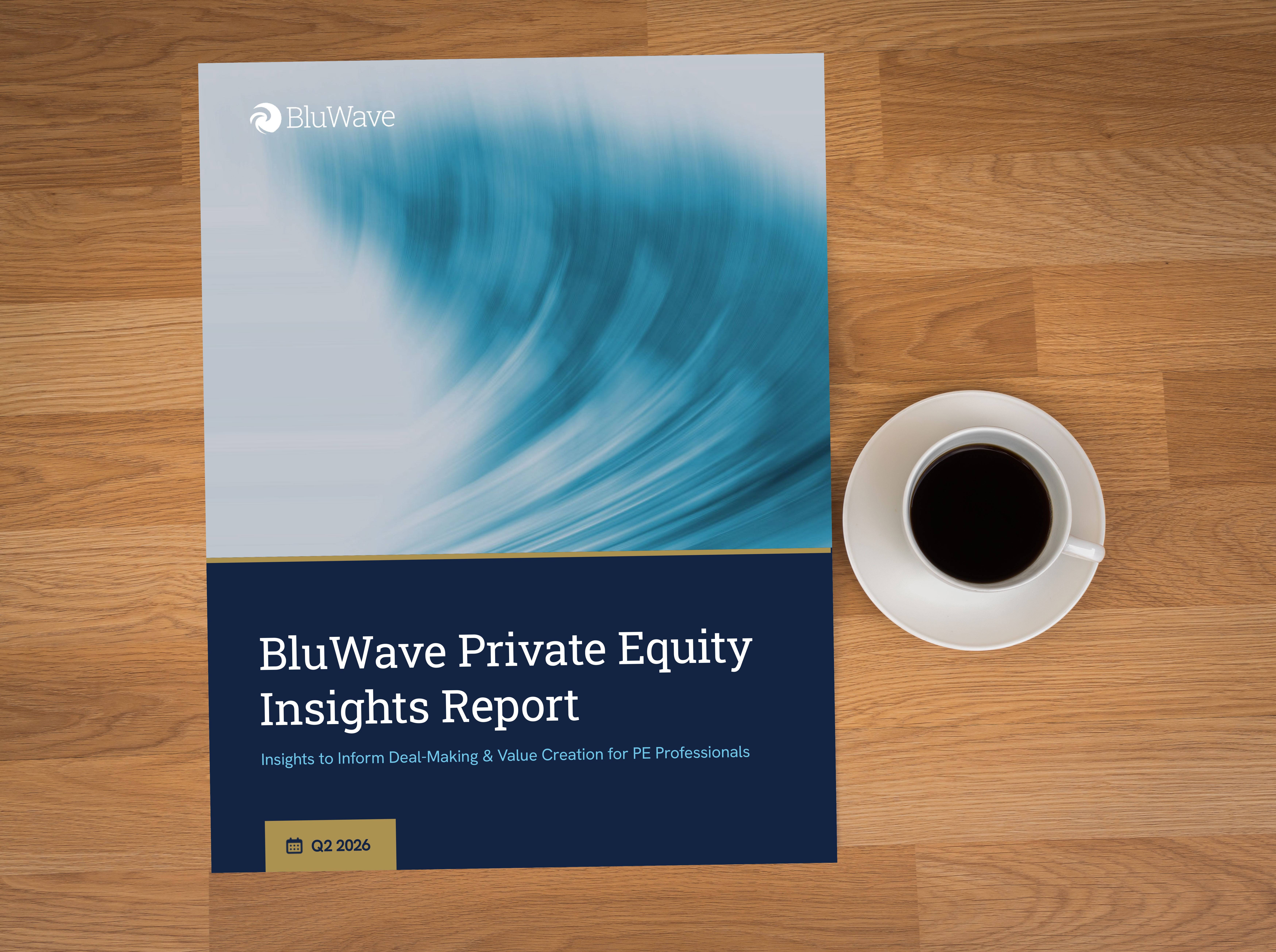
Sean Mooney, Founder and CEO of BluWave, breaks down BluWave’s Q2 2026 Private Equity Insights Report and what it signals for the second half of the year. He explains why renewed geopolitical volatility stalled due diligence to an all-time low, how PE firms responded by pushing value creation to a record 84% of activity, and why AI advisory demand continues to surge across the industry. Sean also revisits BluWave’s 2026 predictions on deal flow, growth, software selection, industrialization, and the widening gap between AI adopters and laggards. For PE leaders deciding where to place their bets this year, it’s the quarter’s playbook in one sitting — press play.
Episode Highlights
- 1:08 – Why BluWave’s project data mirrors where private equity is actually spending time
- 3:45 – Geopolitical disruption stalls new deal activity for the second straight year
- 5:51 – Due diligence drops to 16% as value creation hits an all-time high
- 6:30 – AI advisory services surge 193% year over year in PE
- 7:20 – Reading the macro backdrop: manufacturing PMI, tight credit spreads, and a resilient consumer
- 13:10 – Why extended holds are driving a surge in interim, PE-grade executives
- 23:31 – The case for adopting AI now, before the gap between winners and laggards widens
For more on BluWave, visit: https://www.bluwave.net/
To request the full Q2 2026 Insights Report, visit: https://bluwave.net/resources/insights-report
• 29 min
Private Equity in Q2 2026: Deals Stall as Value Creation Peaks
Private Equity Podcast: Karma School of Business
Play
Transcript
Sean Mooney:
Welcome to the Karma School of Business, a podcast about the private equity industry, business best practices, and real-time trends. I'm Sean Mooney, BluWave's founder and CEO. In this episode, we have a special edition where we talk about what the private equity industry has been up to in Q2 2026, and what it means for the rest of the year.
Enjoy.
Welcome to a special episode of the Karma School of Business. Today, we're going to go through BluWave's Q2 Private Equity Insight Report. For the background of our listeners, BluWave is this super connective backbone for the private equity industry. Many hundreds of PE firms use us. They use us as kind of their magic toolbox for diligence and value creation.
We connect them with all the very best-in-class third-party resources they need to enable, equip, enact their value creation plans, their diligence plans. So in many ways, what we are is we're a mirror reflection of what private equity does and needs. And so what happens from us is, when we look at all these projects coming in, it's a statistically significant representation of what PE does overall.
We can see the story of private equity as it plays out over time and changes in time, and really where the story of the best business builders in the world are. And one of the things that we do is give this information back to our listeners, our customers, et cetera, in order to make them better business builders.
If you think about PE, they're probably under the most pressure in the entire world to build companies with speed and certainty. They can't ever be wrong, because the multiples of money are just not high enough. So venture capital, they aim to be right one or two times out of ten. Private equity has to be right nine and a half or ten times out of ten in order to make money.
And so what that means is they're making very high value, expected value plays with their businesses and how they do diligence, because they have to create value, and yet they can't screw up. And so if you think about size of outcome versus probability of success, that's one of the big reasons why the private equity industry has outperformed every single asset class over time.
And so what that means for business builders is: do as they do, because they're doing the math in terms of what's the biggest outcome times the probability of success, which will create the highest expected value. And so we've been publishing these reports for the last several years. I find these personally tremendously valuable because it tells the story of commerce. It also informs how I manage BluWave myself, as does our team.
So let's go through the last quarter, and it's going to feel a lot like the last quarter or the similar quarter in 2025. And so what happened during this year was the economy was getting ready to boom. It was gaining value, gaining strength.
The deal market was going faster and faster, and then we had a geopolitical crisis in the Middle East, and then that ground everything on due diligence and new deals to a halt, and then the value creation took off in response. To some of you, that might sound very familiar. Second verse, same as the first to last year, when the first quarter the economy was picking up, it was booming, the deal market was taking off, and then what we had was a geopolitical crisis in the Middle East, which shut down the deal market, and then the deal market came back.
I have a feeling the same thing's going to happen this year. We'll talk more about that later. And so during this conversation, we'll talk about the due diligence value creation overall trends that we're seeing in private equity. We're going to talk about the posture of growth versus maybe profitability and cost savings.
Then we're going to talk about some of the predictions we made earlier this year, and whether or not we think they're still holding true, and/or if we have to amend some of those. And so buckle in, this is going to be a good one.
So overall, the big trends, once again, this is second verse, same as the first. I said it, I think, in the prior quarter: this feels like the movie Groundhog Day with Bill Murray, where it just happens again and again. And so here we are. The big trend is we take all the data, and you put this into a pyramid of what's going on. The headline is: PE is looking to the future, but why are they frustrated by the present, much like many of us?
The economy was picking up. The deal market was getting ready to have, I think, a banner year, and then a global crisis came in, and that stalled the deal market within the second quarter. Now, let's talk about why does a global crisis like this stall a deal market? For those of you outside of PE, it may not seem totally apparent, although I think for many it is.
Essentially, if you're going to take a company to market, particularly in private equity, where you have worked 3 to 7 years to build value, and sometimes 10 years to build value, you need a period of time, call it 6 months, where you can go into the market, know that it's going to be good enough and relatively stable without a flash flood coming across the stream and sweeping you off your feet, so that you can go into market, get buyers excited, tell your story, and then exit.
And you want to do that in kind of a 6-month sprint. If you're not sure if there's going to be a flash flood, proverbially, and some kind of crazy event that comes through, you're basically going to say, "You know what? We're going to just wait. Let's let this storm pass, and then we'll take our company out." That's what happened last year, and that's what I think is going to happen this year.
But essentially, what we saw was everyone basically parked their companies that were about to come to market saying, "Let's see how this goes away." And that's what happened in the second quarter. We saw all-time lowest levels of due diligence activity within the BluWave ecosystem. So that was a major change, but it was an extension or maybe a copy-paste of what happened last year.
Then what we saw with private equity firms essentially saying, "We're extending our holds again," they went to work big time within their portfolio companies. So if there's no deals in the market, you're extending holds, you're going to pull the value creation lever, and that's what PE did. So the flip side of the 16% of BluWave activity with PE is due diligence was: 84% of activity was value creation, all-time highest.
And so PE firms are massively working on creating value within their portfolio companies. And then part of that, and really the third layer of the foundation of this pyramid, is that we saw private equity run towards AI stronger, faster, more deliberately, and diligently, than we ever have, probably any trend in the history of the industry.
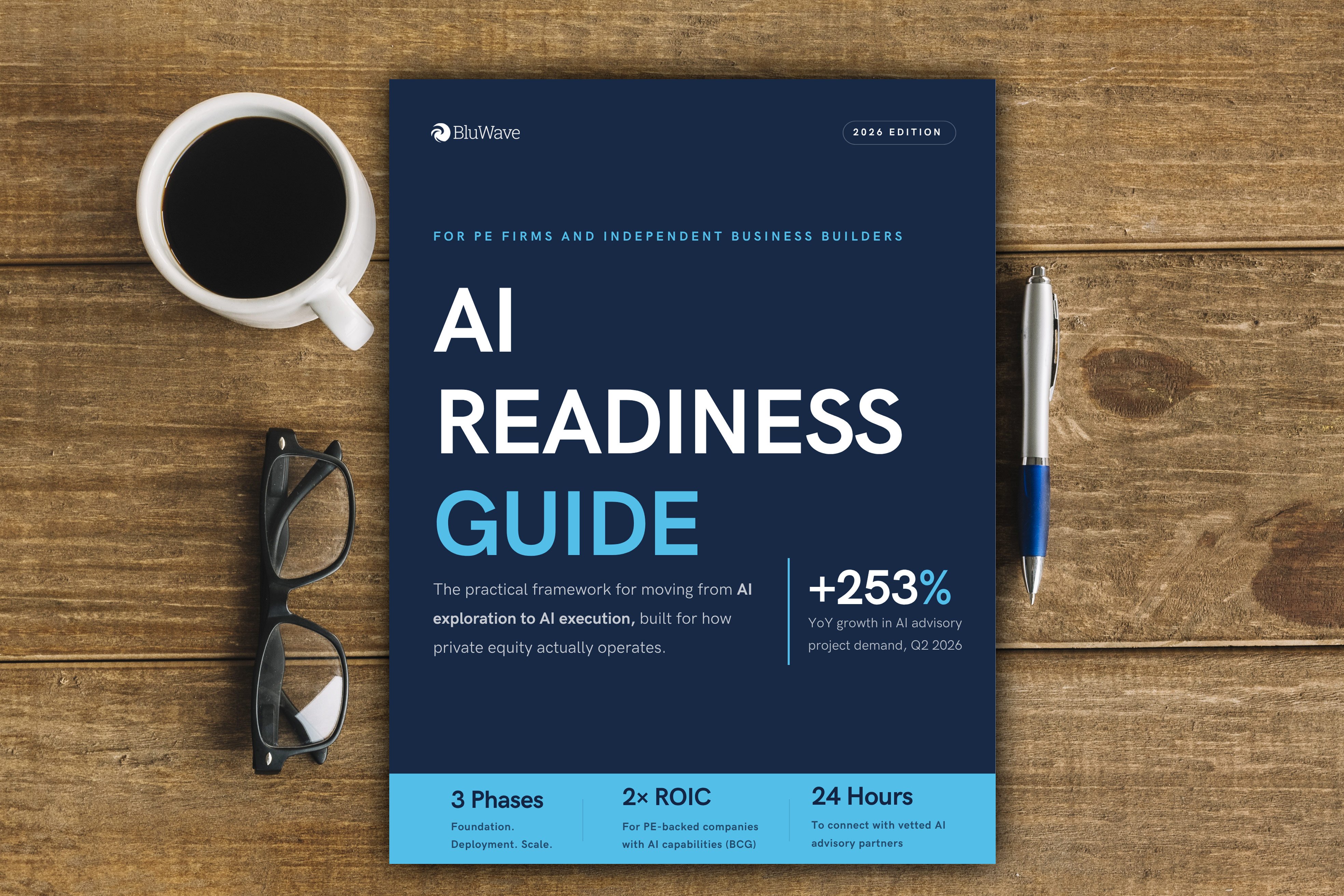
We'll break these down in a moment as we talk about diligence and value creation, but the headline for AI is 193% year-over-year increase in AI advisory services. That's a massive surge in an industry that is very deliberate and purposeful by design. And so the private equity industry is really leaning into this.
We'll talk a little bit further about why essentially there's an ROI to it now, and you can act on it. As we look into the future as well, I'll just talk a little bit about the macroeconomic backdrop as we reach the end of the quarter. And as we looked at this, and I think the industry is looking at this, is the economy continues to be good enough, and surprisingly good enough, and dare I say really good, other than a couple key areas.
So the one thing that I look at, particularly as a broad-based economy, is the US manufacturing PMI, which measures the expansion of the manufacturing sector. As you look at the manufacturing sector going back a couple years, it is our analysis, and I think others like Morgan Stanley, that basically believed, and the data showed, that the manufacturing industry was in a pretty bad recession for a couple years of time.
Now, we have seen 11 straight months of the PMI expanding, and so it's at 53.9. So manufacturing is picking up and up, and that's a good thing for our economy, particularly a broad-based economy. The other thing is, if we look at credit spreads, high yield credit spreads, they're pretty much at a cycle low.
So they're on average at 275 bps, which is a fraction of recessionary levels, which is meaning lenders are open, so deals can proceed, and when they do, they're getting funding. The other thing that we're seeing is that consumers, even if you look at consumer sentiment, which is not great, it's pretty poor. Consumers keep on spending. So if we looked at the May report, retail sales rose around point 9 percent, beating forecast with the core control group at about 0.7%. So while sentiment sat at near record lows, spending stayed resilient. And then the other thing I will say is this job market continues to be on the hot end of hot.
4.2% is a tight job market, particularly when in the context of most economists viewing full employment in the range of 4-5%. So overall, people are getting jobs, they're spending money, the industrial sector is improving, and lenders are open, which means we have an economy that's good enough, and we have preconditions for the deal market to come back when things settle down geopolitically, and people can start seeing those windows of time to confidently bring their companies out.
And by the way, as a newsflash, we're already seeing diligence starting to pick up. I think in some ways what's going on in the Middle East, while very scary and volatile and hard to understand, is just becoming part of, I think, the day-to-day life of many. And so we're starting to see deals starting to come out with more velocity right now as we speak.
Hey, as a quick interlude, this is Sean here.
Wanted to address one quick question that we regularly get. We often get people who show up at our website, call our account executives, they say, "Hey, I'm not private equity. Can I still use BluWave to get connected with resources?" And the short answer is: yes.
Even though we're mostly and largely used by hundreds of private equity firms, thousands of their portfolio company leaders, every day we get calls from everyday top proactive business leaders at public companies, independent companies, family companies.
So absolutely, you can use us as well. If you want to use the exact same resources that are trusted and being deployed and perfectly calibrated for your business needs, give us a call, visit our website at bluwave.net.
Thanks. Back to the episode.
But let's go back to some of the things that we saw in the quarter. If we think about also the perspective of private equity, they often have these kind of oscillating pendulums of, are we going to really fuel projects that drive top-line growth, or are we going to do things that kind of improve profitability and reduce costs?
And so BluWave has this private equity priority index, the PEP index, that we produce every quarter. And what was really interesting, most quarters it's in the growth index. Last year, right when the Middle East latest arrived, it went pretty meaningfully to the all-time lowest kind of cost savings index.
The good news is, in the second quarter, that bumped right back up, and so the posture within PE is once again towards growth. The good news is, I think most people who are in this industry realize, particularly a mature industry like PE, the way you make money is by growing companies, not cutting costs. And the vast majority of all our measures show that.
Let's go to what's actually happening in the quarter. We talked about 84% of the activity in Q2 2026 was value creation. 16% was due diligence.
Let's go to diligence first, where everything starts. Where were people spending time? The usual places. The biggest category they spent time was on strategy. Human capital, senior advisors were next. Operations, looking at the operations. Are they effective? Are there cost savings opportunity? Technology was a pretty meaningful increase versus the last quarter. So people are now starting to not just do tech diligence, meaning let's look at the cloud infrastructure, the license compliance.
If they have software, are they notating it correctly? Cybersecurity. We're now really starting to see AI diligence arrive and be included, or even a separate work stream, in the due diligence process. And then, as always, there's Q of Es and there's sales and marketing. So I do think the market is going to be a lot like last year, where we're going to have a stronger resurgence in the second half for reasons we just discussed. But right now, it's still relatively quiet, but picking up strength.
Let's talk about value creation. As we think about value creation, what we've already discussed is: the AI advisory world is booming, but it's booming pretty broadly. And so even the entire technology segment, which includes AI and everything in technology, was up 80% year-over-year, quarter-over-quarter.
So technology in general, it's not only just are you doing AI advisory, but you're doing data, you're doing business intelligence, and you're doing system selection. That is happening very broadly within the PE world. The other area that continues and always has been our highest category is human capital.
For every call we get for technology, we still get multiple calls from PE about getting the right people in place and getting the right people on the bus, as Jim Collins said. What we're seeing there is a lot of executive hiring. We're seeing a lot of interim executive needs. Why is that? My sense is because holds extended once again, and if you're midstream, and your business has not grown the way it has or should, then the PE firms really have no choice but to make a change.
In large part, they're bringing in new executive teams if it's earlier in the hold. If it's mid to late, they're bringing in interims who are going to be with the company through exit. It's really hard to bring in a new CEO if you're so close to an exit, because they just don't have enough time to really build the equity value.
So the PE firms would rather bring in a PE-grade professional like we have in the ecosystem at BluWave, where they're probably all of them really are materially going to be PE-backed, and the same type of people they would hire full-time. And so they're saying, "Let's basically hold hands, and work this and the economics out on an interim basis until we get to an exit, and then the next buyer, particularly if it's a PE firm, will likely hire you full-time."
That's the big area if you think about this. It's people and tech, and that's most of the story of value creation. We're of course still getting lots of growth strategy. We still get a lot of office of the CFO work, a lot of procurement, a lot of tariff, a lot of Lean Six Sigma, particularly as industrialization is occurring.
That was a prediction we made last year. We were early, but the industrialization of the US is coming back, and it's going to come back more and more and more. Why? Because it's strategic. We need to own the means of production, now that we're no longer arguably the lone superpower, right? So we have global rivals, and if you're going to have a rivaled world, you better be able to make stuff in addition to software.
And so that's what's happening. That will continue to happen, and that was a prediction we made last year. We're really, I think, starting to see more and more of that this year.
Let's talk about the predictions that we made. We made a number of predictions. We make them every year, and then what we do is we revisit them on a quarterly basis, to hold ourselves accountable.
The number one pick we made earlier is that AI is going to stop being treating as a strategy, and it's going to become a tactical force embedded directly into everyday business workflows.
I think we categorically nailed this one. AI enablement advisory services are up 193%. Now, some of that might be selection. That world, to be candid and maybe blunt, is filled with charlatans, and TikTok influencers, who were doing something very different until 3 months ago, and then they have a YouTube channel and saying, "Here's how you do your N8 inflow."
And so the-- I think a lot of the PE industry is wary of that, so they come to us, because we have a professional vetting, onboarding circle of trust system that they use for everything else. So I think some of that number, there may be bias in it, just because we're probably getting more self-selection, but the trend is still the trend, and people are running into this, and why is that?
Because there is very high ROI. And where people are focusing today, it's: get your data right. That's what no one wants to hear, but you have to do that. It's adopting LLMs. You don't need us for that. You can do that yourself. And then there's going to be bringing in AI-enabled tools and also software selection, and then also, namely, I think a lot of people are building their own stuff, and you need safe pairs of hands to do that.
So the AI age is the most exciting thing I've ever seen in my career. And I'll be candid, I have a ratio of 'utterly excited' to 'totally terrified', and it's anywhere between 80% utterly excited and 20% totally terrified, and maybe 60% utterly excited and 40% totally terrified.
It changes per day. But net-net, I am excited about this, because it lets business builders do so much more with so much less. And we're seeing, at least in our team, you're getting a lot more satisfaction because everyone becomes a strategic business builder, versus having to have their hands on keyboard to do the stuff they didn't like.
And so that is, I think, what we're seeing, particularly in areas where there was a lot of hands-on-keyboard, like building code or content. You can come up with the ideas and have that more painful kind of hands-on-keyboard stuff get taken away. That prediction we did quite well with. The other thing which was similar but different, is that AI is exploding the number of software options across every business function.
The PE firms are basically inundated now with BDRs offering them every single software you could ever imagine. And so the other side of this coin of the AI is you can produce software so much faster. And so as a result, everyone's producing software so much faster, and every startup's coming in. It's all different.
It's everything is an AI business. That creates so much choice that people can't make decisions, and people are paralyzed. And I think we absolutely nailed this one again by virtue of all the tech calls we're getting, in particular around software selection. "Which tool do we use? Which one do we don't?"
Particularly in places like the office of CFO, we're getting a lot of those. It's only going to get more and more acute. The tactical piece of advice is: give us a call. We're seeing lots of what everyone's using, and so we can give you some free advice if you're a customer of ours. We can also help you just think through the process that's involved with selecting these tools.
The only other tactical piece of advice I'm offering to our customers and stakeholders is: do your very best not to enter into anything more than a one-year contract. The world is changing so quickly, and there are going to be tools that are better than these legacy ones that are coming out if they don't keep up.
So what you don't want to do is be stuck with a multi-year contract that you can't get out of, and then the whole world has changed behind you. So keep your contracts, if you have to have a contract, to one year at most.
Hey, Karma School listeners, this is Sean with a quick aside. Virtually every day, I'm having conversations with private equity firm professionals and business operators, and we're talking about the same exact thing: where and how do we actually start with AI? The answer is: you start with people who have already done it successfully for others. This is exactly what BluWave does. We have built a one-of-one invitation-only network of trusted AI enablement providers that top private equity firms are using right now to create real value. Private equity-grade quality, pre-vetted by BluWave, ready to go at a moment's notice. And they're not just for PE. Whether you're a PE professional or an operating company CEO, go to BluWave.net. That's B-L-U-W-A-V-E. We'll get you to the right resources so you can start on your AI journey right now.
The next prediction that we made was: after years of uneven growth, the US economy is positioned to heat up this year and entering into the next cycle. This was one that I think we're really very much on track, until we had the latest black swan in the Middle East. As we shared earlier, I think the preconditions are still solid.
If we can bring some calm, or at least a period of calm, where people get comfortable with this being the new normal, then I think everything is still in place for a long-term cycle to continue. And if you listen to Mike Wilson at Morgan Stanley, he's got a very similar take on this, in that the economy fundamentally is quite good.
Why is the Fed not lowering rates? One is inflation, which we have to get better control of. But two is: because the economy is not that bad. And so if we can eliminate this noise, I think all of the preconditions are otherwise there for the economy to continue to pick up. We're seeing signals in places like the PMI, credit spreads, the job market, et cetera.
So people are voting with their dollars, but we haven't seen it in GDP, which is still like ho-hum. Let's keep a pin in that one, and let's watch and see.
The next prediction we had was the structural forces driving a PE rebound remain in place. Aging assets, LP demands, and over a trillion dollars of dry powder, are going to increase deal volume.
Once again, this thing was ready, and it was happening, and by all measures, our conversations with our investment bankers and our ecosystem, with the PE firms that we regularly keep in touch with, everything was all systems go until the Middle East crisis reemerged. So this is another one. We are staring at signals of it picking back up again.
My end-of-the-day assumption here is: I think it's going to be a lot like last year, where it started looking quite strong. The wind got taken out of the sails, then the sails were pulled back up, the market gained strength. I think we ultimately will gain strength again in the second half of the market. Part of it is because the deals have to trade.
We're at all-time highest levels of inventory in the PE ecosystem. They have 5 years to invest, and 10 years to return assets to investors. If you think about maybe a half-life of that at 5 years and the COVID disruption starting in 2022, that gets us to half the funds are going to start materially getting close to aging out starting in 2027.
Now, technically, a PE firm can get an extension. They often do, but there is a lot of fatigue expressed increasingly loudly by the LPs to say, "Return assets." Particularly if you're a PE firm and you want to raise the next fund, you have to return assets. That's just part of the way that world works. And so I think there's going to be deals that trade because they have to.
If I'm on the buy-side, I'm going to be excited, because those are deals that there's going to be some Bs and Cs out there that you can do stuff with, which was like the... When I was in PE, the ultimate dream is like: it's a good company, but there's stuff you can do with it. And then there's going to be the As that can sell in any market. And then if you're going to sell, they're still going to make good money, but just not that last crank on the multiples.
With that, I think the entire market starts getting undone, and then eventually the flywheel spins really quickly, and a ton of deals will start hitting because they have to. So that's just my take on this. I think it's right, but let me know if you think differently.
The very last prediction I had was: we're going to start seeing performance gaps widen in 2026 as AI adoption by not only large companies, but small, medium businesses as well, is going to start separating companies with winners and laggards.
And based on what we're seeing in the demand patterns within PE, PE does things when there's ROI, and we're seeing more and more of that through BluWave, is that this is absolutely happening. My candid response, and this is a bit provocative, is: I think so much of the world is just sleeping through what's going on right now, and they don't want it to be true.
But change is going to win, as it always does. To date myself, I was coming up when the internet came out, and there were so many businesses that said, "This isn't going to happen. You're still going to have these old distribution methods. People are still going to go into the store. We're not going to go to a website."
And they basically perished. The internet won. The metaphor in my mind is: for people who have watched The Office series, you know, seven times through COVID, there was this one episode where Dwight, the iconic salesperson, was against the website, and he goes, "I'm going to show you. I'm going to outsell the website."
And he was working really, really hard, and then he did his best to keep up, and then he starts sweating and he can't keep up, and then eventually the website wins. Well, AI is going to do that. It does not mean that jobs are going away. It does not mean that people go away. It just means we're going to work differently.
And so I do think those who run towards change faster and adopt it will benefit, and we're already seeing that. And so my advice to everyone else is: run towards it, view it with a glass half full, with abundance in mind, and train your team to view it. You're going to have so much more satisfaction because it's the annoying stuff that it's doing, the hands-on-the-keyboard things, and you can talk to it like a peer, or a business partner, or thinking partner, and you can have it do the stuff you don't like, and you have someone to bounce things off of, and you can move so much faster.
For those of you who are interested in some of the things that we're seeing more directly on the AI front, we've hosted a number of webinars. You can reach out to your BluWave account executive or go to our inbox, and we can send you a link to that if you're interested. But that'll also tell you exactly 4 things that we think that everyone should do right now to get ROI and to win the internet age.
And it's exactly what we're doing at BluWave, and it's exactly what we're equipping within the PE ecosystem. Those are all my perspectives for this quarter. I hope this is helpful in terms of pulling back the curtain a little bit. We appreciate you listening. Hopefully, you found value in this episode.
Please give BluWave a call if you need any of these things or more. We're going to give you excellent resources who are private equity-grade, who are meant to give you the greatest outcome with the highest probability of success. It's one of the secrets, it's a risk of sounding commercial, to BluWave is: we use ourselves on ourself.
If we can be helpful to you, we're free to use. Give us a call. We'll help you hopefully add some more excellence with ease to your life. In the meantime, good luck, and onward.
That's all we have for today. Please continue to look for the Karma School of Business podcast anywhere you find your favorite podcasts. We truly appreciate your support.
If you like what you hear, please follow, five-star rate, review, and share. This is a free way to support the show, and it really helps us when you do this, so thank you in advance.
In the meantime, if you want to be connected with the world's best-in-class, private equity-grade professional service providers, independent consultants, interim executives, AI advisors, that are deployed and trusted by the best business builders in the world, including many hundreds of top PE firms, and thousands of portfolio companies, and you can do the same whether or not you're in the PE world, give us a call, or visit our website at bluwave.net. That's B-L-U-W-A-V-E, and we'll support your success.
Onward.
The views and opinions expressed in this program are those of the individuals presenting, and do not necessarily reflect the views or positions of any other persons or entities, including those referenced herein. No representations, warranties, financial, legal, tax, or other advice are made herein.
Consult your advisors regarding any topics discussed during this episode.
Welcome to the Karma School of Business, a podcast about the private equity industry, business best practices, and real-time trends. I'm Sean Mooney, BluWave's founder and CEO. In this episode, we have a special edition where we talk about what the private equity industry has been up to in Q2 2026, and what it means for the rest of the year.
Enjoy.
Welcome to a special episode of the Karma School of Business. Today, we're going to go through BluWave's Q2 Private Equity Insight Report. For the background of our listeners, BluWave is this super connective backbone for the private equity industry. Many hundreds of PE firms use us. They use us as kind of their magic toolbox for diligence and value creation.
We connect them with all the very best-in-class third-party resources they need to enable, equip, enact their value creation plans, their diligence plans. So in many ways, what we are is we're a mirror reflection of what private equity does and needs. And so what happens from us is, when we look at all these projects coming in, it's a statistically significant representation of what PE does overall.
We can see the story of private equity as it plays out over time and changes in time, and really where the story of the best business builders in the world are. And one of the things that we do is give this information back to our listeners, our customers, et cetera, in order to make them better business builders.
If you think about PE, they're probably under the most pressure in the entire world to build companies with speed and certainty. They can't ever be wrong, because the multiples of money are just not high enough. So venture capital, they aim to be right one or two times out of ten. Private equity has to be right nine and a half or ten times out of ten in order to make money.
And so what that means is they're making very high value, expected value plays with their businesses and how they do diligence, because they have to create value, and yet they can't screw up. And so if you think about size of outcome versus probability of success, that's one of the big reasons why the private equity industry has outperformed every single asset class over time.
And so what that means for business builders is: do as they do, because they're doing the math in terms of what's the biggest outcome times the probability of success, which will create the highest expected value. And so we've been publishing these reports for the last several years. I find these personally tremendously valuable because it tells the story of commerce. It also informs how I manage BluWave myself, as does our team.
So let's go through the last quarter, and it's going to feel a lot like the last quarter or the similar quarter in 2025. And so what happened during this year was the economy was getting ready to boom. It was gaining value, gaining strength.
The deal market was going faster and faster, and then we had a geopolitical crisis in the Middle East, and then that ground everything on due diligence and new deals to a halt, and then the value creation took off in response. To some of you, that might sound very familiar. Second verse, same as the first to last year, when the first quarter the economy was picking up, it was booming, the deal market was taking off, and then what we had was a geopolitical crisis in the Middle East, which shut down the deal market, and then the deal market came back.
I have a feeling the same thing's going to happen this year. We'll talk more about that later. And so during this conversation, we'll talk about the due diligence value creation overall trends that we're seeing in private equity. We're going to talk about the posture of growth versus maybe profitability and cost savings.
Then we're going to talk about some of the predictions we made earlier this year, and whether or not we think they're still holding true, and/or if we have to amend some of those. And so buckle in, this is going to be a good one.
So overall, the big trends, once again, this is second verse, same as the first. I said it, I think, in the prior quarter: this feels like the movie Groundhog Day with Bill Murray, where it just happens again and again. And so here we are. The big trend is we take all the data, and you put this into a pyramid of what's going on. The headline is: PE is looking to the future, but why are they frustrated by the present, much like many of us?
The economy was picking up. The deal market was getting ready to have, I think, a banner year, and then a global crisis came in, and that stalled the deal market within the second quarter. Now, let's talk about why does a global crisis like this stall a deal market? For those of you outside of PE, it may not seem totally apparent, although I think for many it is.
Essentially, if you're going to take a company to market, particularly in private equity, where you have worked 3 to 7 years to build value, and sometimes 10 years to build value, you need a period of time, call it 6 months, where you can go into the market, know that it's going to be good enough and relatively stable without a flash flood coming across the stream and sweeping you off your feet, so that you can go into market, get buyers excited, tell your story, and then exit.
And you want to do that in kind of a 6-month sprint. If you're not sure if there's going to be a flash flood, proverbially, and some kind of crazy event that comes through, you're basically going to say, "You know what? We're going to just wait. Let's let this storm pass, and then we'll take our company out." That's what happened last year, and that's what I think is going to happen this year.
But essentially, what we saw was everyone basically parked their companies that were about to come to market saying, "Let's see how this goes away." And that's what happened in the second quarter. We saw all-time lowest levels of due diligence activity within the BluWave ecosystem. So that was a major change, but it was an extension or maybe a copy-paste of what happened last year.
Then what we saw with private equity firms essentially saying, "We're extending our holds again," they went to work big time within their portfolio companies. So if there's no deals in the market, you're extending holds, you're going to pull the value creation lever, and that's what PE did. So the flip side of the 16% of BluWave activity with PE is due diligence was: 84% of activity was value creation, all-time highest.
And so PE firms are massively working on creating value within their portfolio companies. And then part of that, and really the third layer of the foundation of this pyramid, is that we saw private equity run towards AI stronger, faster, more deliberately, and diligently, than we ever have, probably any trend in the history of the industry.
We'll break these down in a moment as we talk about diligence and value creation, but the headline for AI is 193% year-over-year increase in AI advisory services. That's a massive surge in an industry that is very deliberate and purposeful by design. And so the private equity industry is really leaning into this.
We'll talk a little bit further about why essentially there's an ROI to it now, and you can act on it. As we look into the future as well, I'll just talk a little bit about the macroeconomic backdrop as we reach the end of the quarter. And as we looked at this, and I think the industry is looking at this, is the economy continues to be good enough, and surprisingly good enough, and dare I say really good, other than a couple key areas.
So the one thing that I look at, particularly as a broad-based economy, is the US manufacturing PMI, which measures the expansion of the manufacturing sector. As you look at the manufacturing sector going back a couple years, it is our analysis, and I think others like Morgan Stanley, that basically believed, and the data showed, that the manufacturing industry was in a pretty bad recession for a couple years of time.
Now, we have seen 11 straight months of the PMI expanding, and so it's at 53.9. So manufacturing is picking up and up, and that's a good thing for our economy, particularly a broad-based economy. The other thing is, if we look at credit spreads, high yield credit spreads, they're pretty much at a cycle low.
So they're on average at 275 bps, which is a fraction of recessionary levels, which is meaning lenders are open, so deals can proceed, and when they do, they're getting funding. The other thing that we're seeing is that consumers, even if you look at consumer sentiment, which is not great, it's pretty poor. Consumers keep on spending. So if we looked at the May report, retail sales rose around point 9 percent, beating forecast with the core control group at about 0.7%. So while sentiment sat at near record lows, spending stayed resilient. And then the other thing I will say is this job market continues to be on the hot end of hot.
4.2% is a tight job market, particularly when in the context of most economists viewing full employment in the range of 4-5%. So overall, people are getting jobs, they're spending money, the industrial sector is improving, and lenders are open, which means we have an economy that's good enough, and we have preconditions for the deal market to come back when things settle down geopolitically, and people can start seeing those windows of time to confidently bring their companies out.
And by the way, as a newsflash, we're already seeing diligence starting to pick up. I think in some ways what's going on in the Middle East, while very scary and volatile and hard to understand, is just becoming part of, I think, the day-to-day life of many. And so we're starting to see deals starting to come out with more velocity right now as we speak.
Hey, as a quick interlude, this is Sean here.
Wanted to address one quick question that we regularly get. We often get people who show up at our website, call our account executives, they say, "Hey, I'm not private equity. Can I still use BluWave to get connected with resources?" And the short answer is: yes.
Even though we're mostly and largely used by hundreds of private equity firms, thousands of their portfolio company leaders, every day we get calls from everyday top proactive business leaders at public companies, independent companies, family companies.
So absolutely, you can use us as well. If you want to use the exact same resources that are trusted and being deployed and perfectly calibrated for your business needs, give us a call, visit our website at bluwave.net.
Thanks. Back to the episode.
But let's go back to some of the things that we saw in the quarter. If we think about also the perspective of private equity, they often have these kind of oscillating pendulums of, are we going to really fuel projects that drive top-line growth, or are we going to do things that kind of improve profitability and reduce costs?
And so BluWave has this private equity priority index, the PEP index, that we produce every quarter. And what was really interesting, most quarters it's in the growth index. Last year, right when the Middle East latest arrived, it went pretty meaningfully to the all-time lowest kind of cost savings index.
The good news is, in the second quarter, that bumped right back up, and so the posture within PE is once again towards growth. The good news is, I think most people who are in this industry realize, particularly a mature industry like PE, the way you make money is by growing companies, not cutting costs. And the vast majority of all our measures show that.
Let's go to what's actually happening in the quarter. We talked about 84% of the activity in Q2 2026 was value creation. 16% was due diligence.
Let's go to diligence first, where everything starts. Where were people spending time? The usual places. The biggest category they spent time was on strategy. Human capital, senior advisors were next. Operations, looking at the operations. Are they effective? Are there cost savings opportunity? Technology was a pretty meaningful increase versus the last quarter. So people are now starting to not just do tech diligence, meaning let's look at the cloud infrastructure, the license compliance.
If they have software, are they notating it correctly? Cybersecurity. We're now really starting to see AI diligence arrive and be included, or even a separate work stream, in the due diligence process. And then, as always, there's Q of Es and there's sales and marketing. So I do think the market is going to be a lot like last year, where we're going to have a stronger resurgence in the second half for reasons we just discussed. But right now, it's still relatively quiet, but picking up strength.
Let's talk about value creation. As we think about value creation, what we've already discussed is: the AI advisory world is booming, but it's booming pretty broadly. And so even the entire technology segment, which includes AI and everything in technology, was up 80% year-over-year, quarter-over-quarter.
So technology in general, it's not only just are you doing AI advisory, but you're doing data, you're doing business intelligence, and you're doing system selection. That is happening very broadly within the PE world. The other area that continues and always has been our highest category is human capital.
For every call we get for technology, we still get multiple calls from PE about getting the right people in place and getting the right people on the bus, as Jim Collins said. What we're seeing there is a lot of executive hiring. We're seeing a lot of interim executive needs. Why is that? My sense is because holds extended once again, and if you're midstream, and your business has not grown the way it has or should, then the PE firms really have no choice but to make a change.
In large part, they're bringing in new executive teams if it's earlier in the hold. If it's mid to late, they're bringing in interims who are going to be with the company through exit. It's really hard to bring in a new CEO if you're so close to an exit, because they just don't have enough time to really build the equity value.
So the PE firms would rather bring in a PE-grade professional like we have in the ecosystem at BluWave, where they're probably all of them really are materially going to be PE-backed, and the same type of people they would hire full-time. And so they're saying, "Let's basically hold hands, and work this and the economics out on an interim basis until we get to an exit, and then the next buyer, particularly if it's a PE firm, will likely hire you full-time."
That's the big area if you think about this. It's people and tech, and that's most of the story of value creation. We're of course still getting lots of growth strategy. We still get a lot of office of the CFO work, a lot of procurement, a lot of tariff, a lot of Lean Six Sigma, particularly as industrialization is occurring.
That was a prediction we made last year. We were early, but the industrialization of the US is coming back, and it's going to come back more and more and more. Why? Because it's strategic. We need to own the means of production, now that we're no longer arguably the lone superpower, right? So we have global rivals, and if you're going to have a rivaled world, you better be able to make stuff in addition to software.
And so that's what's happening. That will continue to happen, and that was a prediction we made last year. We're really, I think, starting to see more and more of that this year.
Let's talk about the predictions that we made. We made a number of predictions. We make them every year, and then what we do is we revisit them on a quarterly basis, to hold ourselves accountable.
The number one pick we made earlier is that AI is going to stop being treating as a strategy, and it's going to become a tactical force embedded directly into everyday business workflows.
I think we categorically nailed this one. AI enablement advisory services are up 193%. Now, some of that might be selection. That world, to be candid and maybe blunt, is filled with charlatans, and TikTok influencers, who were doing something very different until 3 months ago, and then they have a YouTube channel and saying, "Here's how you do your N8 inflow."
And so the-- I think a lot of the PE industry is wary of that, so they come to us, because we have a professional vetting, onboarding circle of trust system that they use for everything else. So I think some of that number, there may be bias in it, just because we're probably getting more self-selection, but the trend is still the trend, and people are running into this, and why is that?
Because there is very high ROI. And where people are focusing today, it's: get your data right. That's what no one wants to hear, but you have to do that. It's adopting LLMs. You don't need us for that. You can do that yourself. And then there's going to be bringing in AI-enabled tools and also software selection, and then also, namely, I think a lot of people are building their own stuff, and you need safe pairs of hands to do that.
So the AI age is the most exciting thing I've ever seen in my career. And I'll be candid, I have a ratio of 'utterly excited' to 'totally terrified', and it's anywhere between 80% utterly excited and 20% totally terrified, and maybe 60% utterly excited and 40% totally terrified.
It changes per day. But net-net, I am excited about this, because it lets business builders do so much more with so much less. And we're seeing, at least in our team, you're getting a lot more satisfaction because everyone becomes a strategic business builder, versus having to have their hands on keyboard to do the stuff they didn't like.
And so that is, I think, what we're seeing, particularly in areas where there was a lot of hands-on-keyboard, like building code or content. You can come up with the ideas and have that more painful kind of hands-on-keyboard stuff get taken away. That prediction we did quite well with. The other thing which was similar but different, is that AI is exploding the number of software options across every business function.
The PE firms are basically inundated now with BDRs offering them every single software you could ever imagine. And so the other side of this coin of the AI is you can produce software so much faster. And so as a result, everyone's producing software so much faster, and every startup's coming in. It's all different.
It's everything is an AI business. That creates so much choice that people can't make decisions, and people are paralyzed. And I think we absolutely nailed this one again by virtue of all the tech calls we're getting, in particular around software selection. "Which tool do we use? Which one do we don't?"
Particularly in places like the office of CFO, we're getting a lot of those. It's only going to get more and more acute. The tactical piece of advice is: give us a call. We're seeing lots of what everyone's using, and so we can give you some free advice if you're a customer of ours. We can also help you just think through the process that's involved with selecting these tools.
The only other tactical piece of advice I'm offering to our customers and stakeholders is: do your very best not to enter into anything more than a one-year contract. The world is changing so quickly, and there are going to be tools that are better than these legacy ones that are coming out if they don't keep up.
So what you don't want to do is be stuck with a multi-year contract that you can't get out of, and then the whole world has changed behind you. So keep your contracts, if you have to have a contract, to one year at most.
Hey, Karma School listeners, this is Sean with a quick aside. Virtually every day, I'm having conversations with private equity firm professionals and business operators, and we're talking about the same exact thing: where and how do we actually start with AI? The answer is: you start with people who have already done it successfully for others. This is exactly what BluWave does. We have built a one-of-one invitation-only network of trusted AI enablement providers that top private equity firms are using right now to create real value. Private equity-grade quality, pre-vetted by BluWave, ready to go at a moment's notice. And they're not just for PE. Whether you're a PE professional or an operating company CEO, go to BluWave.net. That's B-L-U-W-A-V-E. We'll get you to the right resources so you can start on your AI journey right now.
The next prediction that we made was: after years of uneven growth, the US economy is positioned to heat up this year and entering into the next cycle. This was one that I think we're really very much on track, until we had the latest black swan in the Middle East. As we shared earlier, I think the preconditions are still solid.
If we can bring some calm, or at least a period of calm, where people get comfortable with this being the new normal, then I think everything is still in place for a long-term cycle to continue. And if you listen to Mike Wilson at Morgan Stanley, he's got a very similar take on this, in that the economy fundamentally is quite good.
Why is the Fed not lowering rates? One is inflation, which we have to get better control of. But two is: because the economy is not that bad. And so if we can eliminate this noise, I think all of the preconditions are otherwise there for the economy to continue to pick up. We're seeing signals in places like the PMI, credit spreads, the job market, et cetera.
So people are voting with their dollars, but we haven't seen it in GDP, which is still like ho-hum. Let's keep a pin in that one, and let's watch and see.
The next prediction we had was the structural forces driving a PE rebound remain in place. Aging assets, LP demands, and over a trillion dollars of dry powder, are going to increase deal volume.
Once again, this thing was ready, and it was happening, and by all measures, our conversations with our investment bankers and our ecosystem, with the PE firms that we regularly keep in touch with, everything was all systems go until the Middle East crisis reemerged. So this is another one. We are staring at signals of it picking back up again.
My end-of-the-day assumption here is: I think it's going to be a lot like last year, where it started looking quite strong. The wind got taken out of the sails, then the sails were pulled back up, the market gained strength. I think we ultimately will gain strength again in the second half of the market. Part of it is because the deals have to trade.
We're at all-time highest levels of inventory in the PE ecosystem. They have 5 years to invest, and 10 years to return assets to investors. If you think about maybe a half-life of that at 5 years and the COVID disruption starting in 2022, that gets us to half the funds are going to start materially getting close to aging out starting in 2027.
Now, technically, a PE firm can get an extension. They often do, but there is a lot of fatigue expressed increasingly loudly by the LPs to say, "Return assets." Particularly if you're a PE firm and you want to raise the next fund, you have to return assets. That's just part of the way that world works. And so I think there's going to be deals that trade because they have to.
If I'm on the buy-side, I'm going to be excited, because those are deals that there's going to be some Bs and Cs out there that you can do stuff with, which was like the... When I was in PE, the ultimate dream is like: it's a good company, but there's stuff you can do with it. And then there's going to be the As that can sell in any market. And then if you're going to sell, they're still going to make good money, but just not that last crank on the multiples.
With that, I think the entire market starts getting undone, and then eventually the flywheel spins really quickly, and a ton of deals will start hitting because they have to. So that's just my take on this. I think it's right, but let me know if you think differently.
The very last prediction I had was: we're going to start seeing performance gaps widen in 2026 as AI adoption by not only large companies, but small, medium businesses as well, is going to start separating companies with winners and laggards.
And based on what we're seeing in the demand patterns within PE, PE does things when there's ROI, and we're seeing more and more of that through BluWave, is that this is absolutely happening. My candid response, and this is a bit provocative, is: I think so much of the world is just sleeping through what's going on right now, and they don't want it to be true.
But change is going to win, as it always does. To date myself, I was coming up when the internet came out, and there were so many businesses that said, "This isn't going to happen. You're still going to have these old distribution methods. People are still going to go into the store. We're not going to go to a website."
And they basically perished. The internet won. The metaphor in my mind is: for people who have watched The Office series, you know, seven times through COVID, there was this one episode where Dwight, the iconic salesperson, was against the website, and he goes, "I'm going to show you. I'm going to outsell the website."
And he was working really, really hard, and then he did his best to keep up, and then he starts sweating and he can't keep up, and then eventually the website wins. Well, AI is going to do that. It does not mean that jobs are going away. It does not mean that people go away. It just means we're going to work differently.
And so I do think those who run towards change faster and adopt it will benefit, and we're already seeing that. And so my advice to everyone else is: run towards it, view it with a glass half full, with abundance in mind, and train your team to view it. You're going to have so much more satisfaction because it's the annoying stuff that it's doing, the hands-on-the-keyboard things, and you can talk to it like a peer, or a business partner, or thinking partner, and you can have it do the stuff you don't like, and you have someone to bounce things off of, and you can move so much faster.
For those of you who are interested in some of the things that we're seeing more directly on the AI front, we've hosted a number of webinars. You can reach out to your BluWave account executive or go to our inbox, and we can send you a link to that if you're interested. But that'll also tell you exactly 4 things that we think that everyone should do right now to get ROI and to win the internet age.
And it's exactly what we're doing at BluWave, and it's exactly what we're equipping within the PE ecosystem. Those are all my perspectives for this quarter. I hope this is helpful in terms of pulling back the curtain a little bit. We appreciate you listening. Hopefully, you found value in this episode.
Please give BluWave a call if you need any of these things or more. We're going to give you excellent resources who are private equity-grade, who are meant to give you the greatest outcome with the highest probability of success. It's one of the secrets, it's a risk of sounding commercial, to BluWave is: we use ourselves on ourself.
If we can be helpful to you, we're free to use. Give us a call. We'll help you hopefully add some more excellence with ease to your life. In the meantime, good luck, and onward.
That's all we have for today. Please continue to look for the Karma School of Business podcast anywhere you find your favorite podcasts. We truly appreciate your support.
If you like what you hear, please follow, five-star rate, review, and share. This is a free way to support the show, and it really helps us when you do this, so thank you in advance.
In the meantime, if you want to be connected with the world's best-in-class, private equity-grade professional service providers, independent consultants, interim executives, AI advisors, that are deployed and trusted by the best business builders in the world, including many hundreds of top PE firms, and thousands of portfolio companies, and you can do the same whether or not you're in the PE world, give us a call, or visit our website at bluwave.net. That's B-L-U-W-A-V-E, and we'll support your success.
Onward.
The views and opinions expressed in this program are those of the individuals presenting, and do not necessarily reflect the views or positions of any other persons or entities, including those referenced herein. No representations, warranties, financial, legal, tax, or other advice are made herein.
Consult your advisors regarding any topics discussed during this episode.
Karma School of Business
Private equity insights for and with top business builders, including investors, operators, executives and industry thought leaders. The Karma School of Business Podcast goes behind the scenes of PE, talking about business best practices and real-time industry trends. You'll learn from leading professionals and visionary business executives who will help you take action and enhance your life, whether you’re at a PE firm, a portco or a private or public company.
BluWave Founder & CEO Sean Mooney hosts the Private Equity Karma School of Business Podcast. BluWave is the business builders’ network for private equity grade due diligence and value creation needs.
Related Articles
Private Equity Deal Sourcing with Audax’s Dave Santoni
EPISODE 148

How PE Firms Use AI Advisory Services
"AI advisory services" are projects done with outside specialists who help a company figure out...

How to Vet an AI Advisory Firm Before You Sign
Choose an AI advisor by matching the type of provider to the type of problem, then vetting for...
BluWave PE Insights Report
Connect with
a pre-vetted
resource now
Do you need an exact-fit, PE-grade, third-party resource for your nuanced due diligence, value creation, or prep-for-sale work? We've got you covered.
To learn more or start a project, contact our client success team at 615-588-4010 or fill out the form to have us call you.