


Pricing Strategy for Private Equity
Trusted by 500+ private equity firms including:

.png)

.png)

.png)




Pricing strategy is one of the few levers in the value-creation toolkit that generates material EBITDA improvement without proportional cost increases. For PE-backed companies, that makes it one of the most efficient paths to margin expansion — and, ultimately, to multiple expansion at exit.
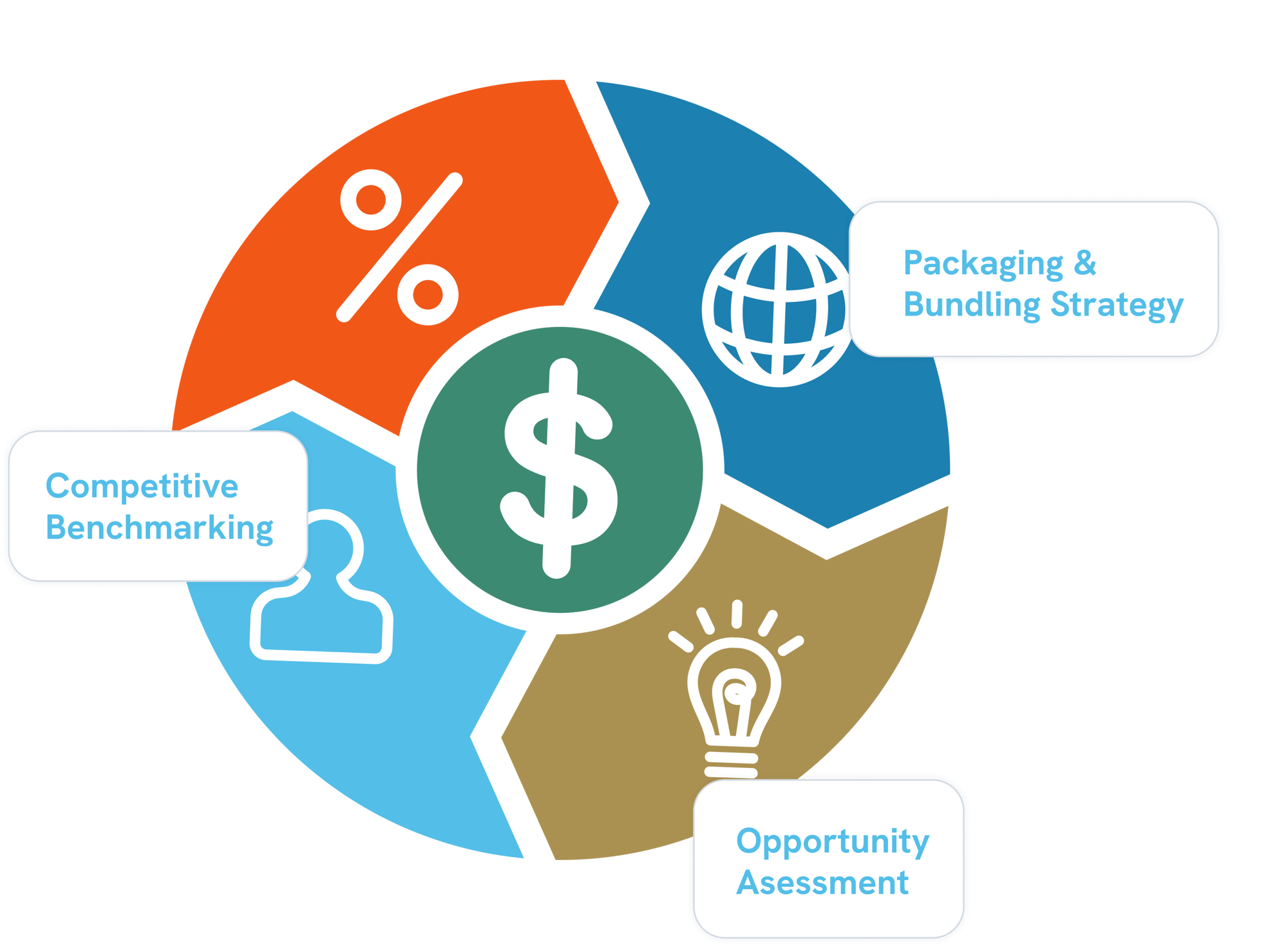
Whether the issue is undisciplined discounting, margin that never reaches EBITDA, a mismatch between perceived and captured value, or simply the absence of a structured pricing architecture, the impact is the same: a gap between the revenue a business generates and the revenue it could. Pricing strategy experts work to close that gap by auditing current pricing structures, benchmarking competitively, and building a pricing model — including price realization discipline — aligned to the company's value proposition and market position.
Finding the right expert for that work requires its own precision. The BluWave Vetted™ network includes pricing specialists who operate specifically within PE-backed environments, with proven experience in value creation plans, pre-exit optimization, and commercial pricing transformation — matched to your exact need, not pulled from a generic vendor list.

How do PE firms scope a go-to-market engagement?
Go-to-market work in a PE-backed company starts where growth strategy ends. The thesis tells you which customers to win and which markets to enter. Go-to-market tells you how to actually win them: the sales motion that converts, the channels that scale, the playbook the sales team can run, and the demand engine that fills the pipeline against the value creation plan.
Most engagements scope around four anchors:
- Sales motion design rebuilds how the company actually sells, typically when a portco has acquired its way to scale but never rebuilt the sales process across the combined entity.
- Channel strategy decides where to invest: direct, partner, inside, distribution, or hybrid, almost always under a hold-period clock and against a value creation lever named in the deal model.
- Sales playbook and enablement turns the strategy into something a national sales team can repeat: ICP execution, messaging, battle cards, ramp plans, segmented outreach.
- Customer acquisition planning aligns demand generation to the commercial plan, from outbound motion design to digital and lead generation routing.
PE-grade go-to-market specialists are rare because most consultants in this space hit one of two failure modes. MBB and big-firm strategy teams build the deck but won’t run the pipeline. In-house hires can’t move at PE pace. The right specialist has done this work inside PE-backed sub-$2B companies, can read the model and the management team in the same week, and can design and implement, not just diagnose.
Types of go-to-market strategy
- Sales playbook design
- Customer acquisition strategy
- Sales motion design
- Demand generation strategy
- Channel strategy
- Route-to-market strategy
- B2B go-to-market strategy
- Sales enablement
- SaaS go-to-market strategy
- Outbound motion design
- Account-based marketing strategy
- Inside sales build
- Pipeline generation strategy
- Pre-LOI GTM roadmap
- Post-acquisition GTM build
- New product launch GTM
- RevOps enablement
- Channel partner strategy
- ICP execution
- Commercial roadmap design
- Sales playbook design
- Customer acquisition strategy
- Sales motion design
- Demand generation strategy
- Channel strategy
- Route-to-market strategy
- B2B go-to-market strategy
- Sales enablement
- SaaS go-to-market strategy
- Outbound motion design
- Account-based marketing strategy
- Inside sales build
- Pipeline generation strategy
- Pre-LOI GTM roadmap
- Post-acquisition GTM build
- New product launch GTM
- RevOps enablement
- Channel partner strategy
- ICP execution
- Commercial roadmap design
BluWave has PE-grade go-to-market strategy experts for every need
Pre-LOI GTM roadmap vs. post-close GTM build
Pre-LOI work feeds the value creation plan. A pre-acquisition go-to-market roadmap pressure-tests the revenue assumptions in the model and produces a 12-to-18-month commercial plan that becomes the post-close playbook.
Post-close work executes against the model. The 100-day go-to-market build stands up the sales motion, the channel mix, and the demand engine the deal team underwrote. Both run under the same hold-period clock.
Also referred to as: go-to-market consulting, GTM strategy, commercial growth strategy, sales motion design, route-to-market strategy
Industries We Serve
- Manufacturing
- SaaS & Software
- Healthcare Services
- Business Services
- Distribution
- Food & Beverage
- Industrial Services
- Consumer Products
- Technology Services
- Professional Services
- Construction & Engineering
- Manufacturing
- SaaS & Software
- Healthcare Services
- Business Services
- Distribution
- Food & Beverage
- Industrial Services
- Consumer Products
- Technology Services
- Professional Services
- Construction & Engineering
Bluwave has pricing stratgies for every industry
Northstar Capital
When PE operating partners engage go-to-market specialists
Industries We Work In
- Manufacturing
- Retail
- SaaS
- Food Services
- Medical Device
- Residential Services
- Competitive Benchmarking
- Revenue Management
- Manufacturing
- Retail
- SaaS
- Food Services
- Medical Device
- Residential Services
- Competitive Benchmarking
- Revenue Management
BluWave has go-to-market solutions for every industry
Where personal networks and generalist firms miss PE pace
- Post-close commercial build. First 100 days post-close, the sales motion the deal team underwrote needs to be built and running before the next operating partner review.
- Stalled mid-hold motion. Revenue is below plan 18 months in, the original playbook isn’t working, and the board needs a credible reset before the next IC review.
- Pre-exit revenue acceleration. Twelve to eighteen months from sale, the commercial engine needs to show repeatable pipeline and segmented growth, not just a hot year.
- Pre-LOI GTM diligence. The thesis includes commercial scaling, but the target’s GTM infrastructure is immature, and the deal team needs a 12-to-18-month roadmap built into the VCP.
Industries We Serve
- Manufacturing
- SaaS & Software
- Healthcare Services
- Business Services
- Distribution
- Food & Beverage
- Industrial Services
- Consumer Products
- Technology Services
- Professional Services
- Construction & Engineering
- Manufacturing
- SaaS & Software
- Healthcare Services
- Business Services
- Distribution
- Food & Beverage
- Industrial Services
- Consumer Products
- Technology Services
- Professional Services
- Construction & Engineering
Bluwave has pricing stratgies for every industry
Northstar Capital
Does BluWave help PE firms source go-to-market consultants?
BluWave routes go-to-market work to specialists who have run the playbook inside PE-backed companies: former CROs, CMOs, VPs of Sales, heads of sales operations, and boutique go-to-market operators with sub-$2B portfolio experience. The BluWave Vetted™ network is invite-only and re-vetted against the specific scope of each engagement: the industry, the deal stage, the deliverable, and the timeline.
Each engagement flows through BluWave’s AI matching engine combined with expert human review. The output is a shortlist of two or three specialists matched to scope, industry, deal stage, and timeline, delivered within 24 hours.
BluWave does not take fees from PE firms or portfolio companies for the introduction. Specialists pay BluWave a connection fee when an engagement is signed; the client contracts and pays the specialist directly at market rates. BluWave is paid only when the match holds.
Results That Matter
500+
PE firms served
99%
Network match to need
<24
Hours to resources presented
$0
Cost to connect
Excellent. Fast. Free. Pick All Three.
BluWave bucks the Project Triangle by providing you with excellent (PE-grade, BluWave Vetted™ experts), fast (within 24 hours), and free (we connect you at no cost) solutions that perfectly match your needs.
Excellent Results
BluWave delivers 2–4 best-in-class pricing strategy options matched precisely to your deal, your company's stage, and your industry. Each option has been vetted through BluWave's invite-only ecosystem — no generic providers, no bad fits, no wasted introductions.
Extremely Fast
Vetted pricing strategy experts are presented to you in less than 24 hours. BluWave's AI matching engine (DORE-E) powers the speed and precision.
Free to Use
For the vast majority of pricing strategy engagements, BluWave's connection service is free to PE firms and portfolio companies. You pay the expert you select, at competitive market rates. No finder's fees, no markups, no surprises.
“BluWave is a trusted advisor, and by relying on their expertise in this space, I'm able to focus my attention on other areas of the business.”
Here's what you can get done with BluWave in just 24 hours.
Working with BluWave on a pricing strategy engagement is straightforward. Here is how the process works:
Intake
You submit your need — a brief description of the company, the pricing challenge or opportunity, the industry, and your timeline. No lengthy RFP required.
Scoping
A BluWave expert reviews your intake, asks focused follow-up questions, and defines the scope of the engagement clearly before matching begins.
AI Matching via DORE-E
BluWave's proprietary AI matching engine, DORE-E, runs your criteria against the BluWave Vetted™ network — analyzing industry experience, PE track record, engagement type, and prior performance signals to identify the highest-fit options.
Expert Human Review
Before any options are presented, a BluWave expert reviews the AI-generated recommendations to confirm fit, verify availability, and ensure quality.
Delivery in Less Than 24 Hours
You receive 2–4 curated, vetted pricing strategy options within 24 hours of your intake — ready for introductory calls.
Exact-Fit Alignment
BluWave presents only providers who match your specific criteria. There is no shortlist padding, no paying for placement, and no cost to you unless you select and engage a provider.
Frequently asked questions about pricing strategy
When do PE firms engage pricing strategy experts?
PE firms and portfolio companies typically engage pricing strategy experts at four key moments: during commercial due diligence to validate pricing power, in the first 100 days post-close to audit price realization and identify margin leakage, during active value creation initiatives to restructure pricing tiers or implement value-based models, and in the 12–18 months before a sale process to strengthen pricing metrics and demonstrate commercial discipline to buyers. Each moment carries distinct deliverables and return potential, and the highest-performing value creation plans sequence these engagements deliberately rather than reactively.
What is value-based pricing, and why does it matter in PE?
Value-based pricing is a methodology that sets prices based on the customer's perceived value of a product or service, rather than cost-plus formulas or competitive parity alone. In PE value creation, it matters because cost-plus pricing frequently undervalues differentiated offerings — leaving margin that never reaches EBITDA. For PE-backed companies with defensible products or specialized services, shifting to a value-based pricing model is often the highest-ROI commercial initiative in the value creation plan. It requires customer research and a willingness to test price sensitivity, but when implemented with the right expertise, the margin impact is measurable and durable.
How does BluWave connect PE firms with pricing strategy experts?
How is pricing strategy different from commercial due diligence?
Commercial due diligence is a broad assessment of a target's market position, competitive landscape, and revenue quality. Pricing strategy is a focused discipline that can be conducted within commercial due diligence or as a standalone post-acquisition initiative. While commercial due diligence provides a full-picture view of commercial risk and opportunity, a dedicated pricing strategy engagement goes deeper into the pricing architecture itself — analyzing willingness to pay, discount behavior, tier structure, and monetization model with the intent to produce implementable recommendations that can move directly into a value creation plan.
What industries benefit most from pricing strategy in private equity?
How long does a pricing strategy engagement typically take?
Is pricing strategy more effective pre-acquisition or post-acquisition?
Related insights to pricing strategy


Connect with a vetted go-to-market specialist now.
Go-to-market is rarely the gap the deal team underwrote. It’s the gap that opens 100 days, 18 months, or 36 months after close, when the sales motion the model assumed hasn’t been built, or when the playbook that got the portco here won’t get it sold.
PE firms and portfolio companies come to BluWave when they need a specialist who has already done this work inside PE-backed companies, not someone who will learn it on their time. Matched within 24 hours, at no upfront cost.